How can we inform our own designs by analysing existing designs?
OUTCOME SUMMARY
Unit 3 Outcome 2 focuses on design analysis and the use of visual language to communicate ideas and information effectively.
Students compare and analyse design examples from selected field(s) of design practice, examining how designers use aesthetic considerations to respond to purpose, context and audience or users.
Across the outcome, students analyse messages, objects, environments and interactive experiences, using appropriate Visual Communication Design terminology to describe and evaluate design decisions.
The outcome explicitly develops students’ ability to compare, analyse and evaluate design examples in preparation for School-assessed Coursework and the end-of-year examination.
Students apply conceptions of good design and consider the influence of social, cultural, environmental, economic and technological factors on design outcomes.
OUTLINE
1. Purpose, context and audience
Analyse and compare how two design examples respond to their intended purpose, the context in which they were produced, and the needs of audiences or users.
2. PMI evaluation
Use the PMI framework to analyse and evaluate the strengths, limitations and interesting features of two design examples addressing a shared design problem.
3. Good Design
Analysing how our conceptions of good design influence the functional and aesthetic aspects of design. Looking at how conceptions of good design differ across different audiences.
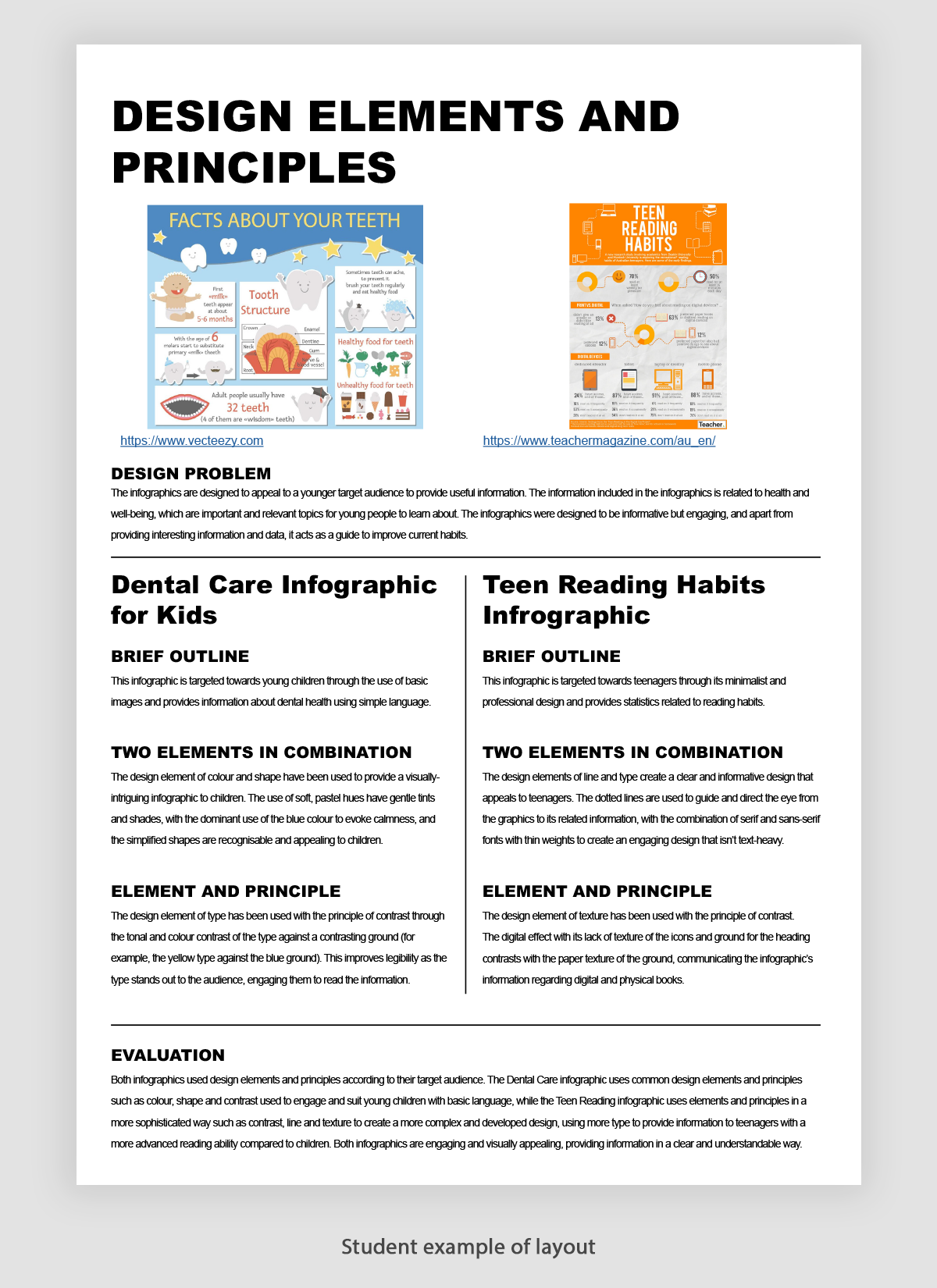
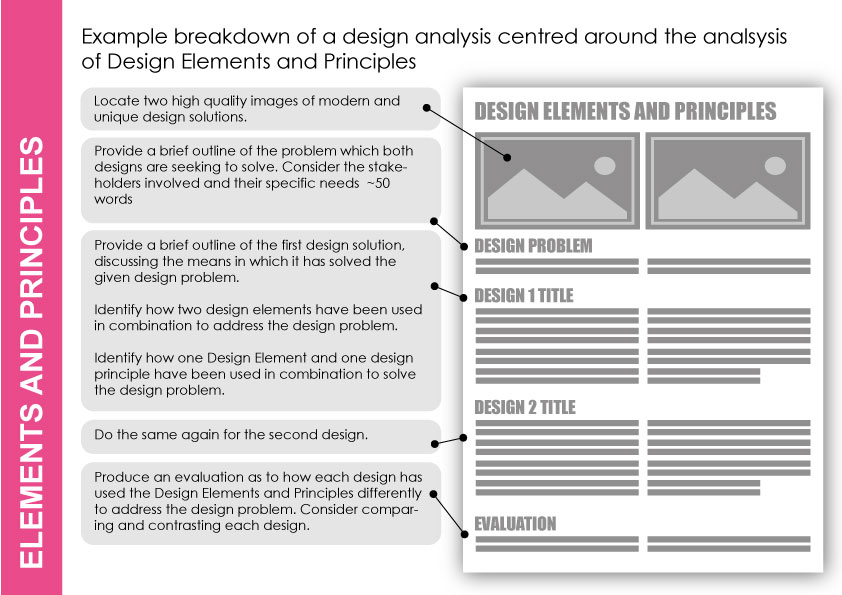
4. Design elements and principles
Analyse how designers use design elements and principles, individually and in combination, to communicate ideas and resolve the design problem.
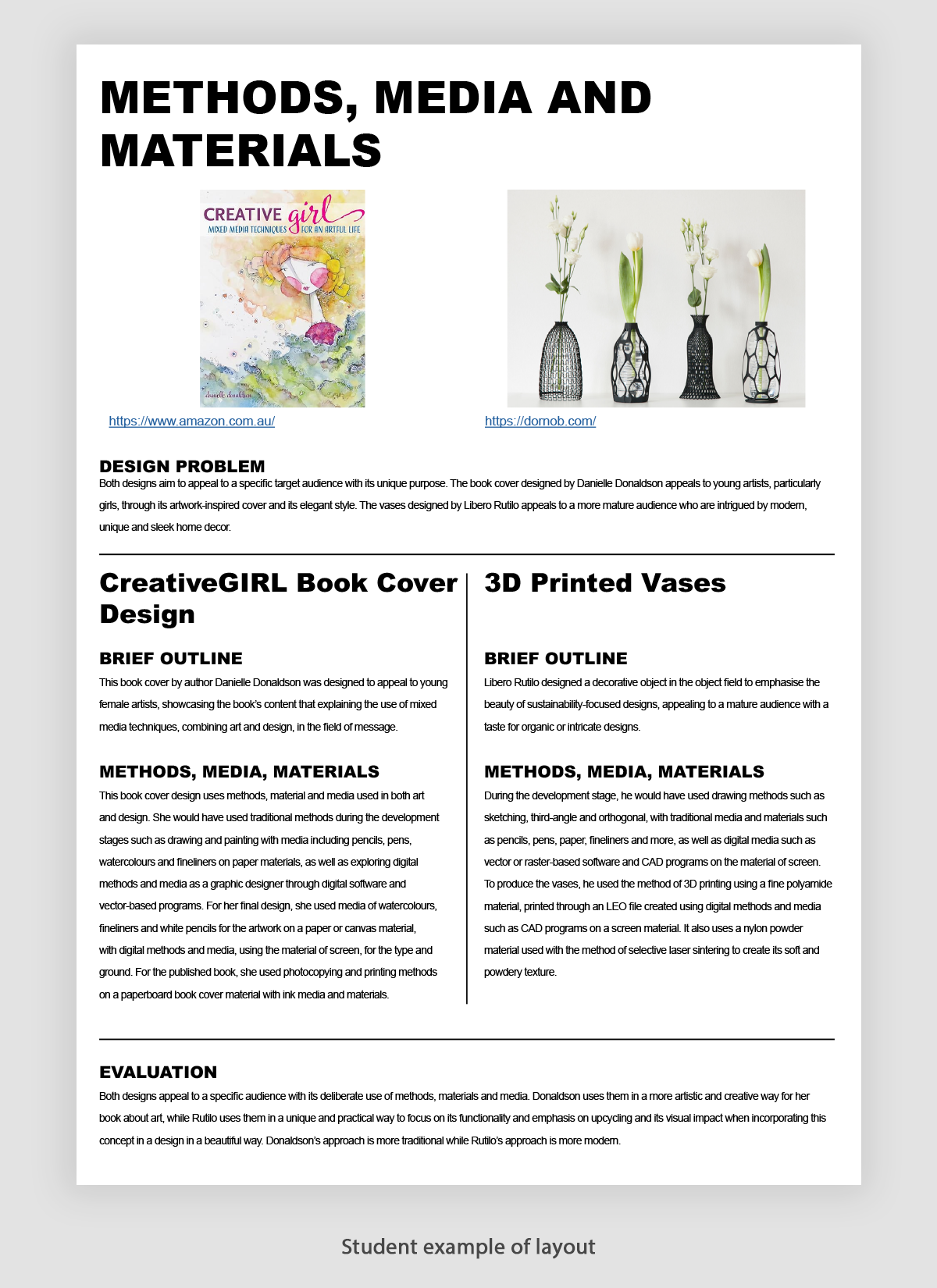
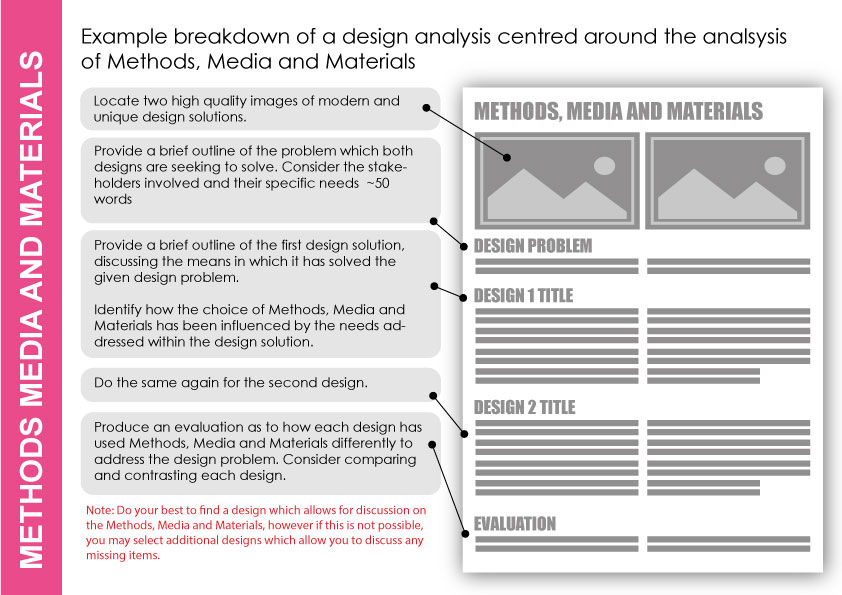
5. Methods, media and materials
Evaluate how the selection and application of methods, media and materials contribute to the aesthetic and functional effectiveness of design solutions.
6. Design factors
Analyse how economic, social, cultural, technological and environmental factors influence design decisions and outcomes.
Written SAC
A written SAC wherein students are to display an understanding of each key skill and knowledge under timed conditions.
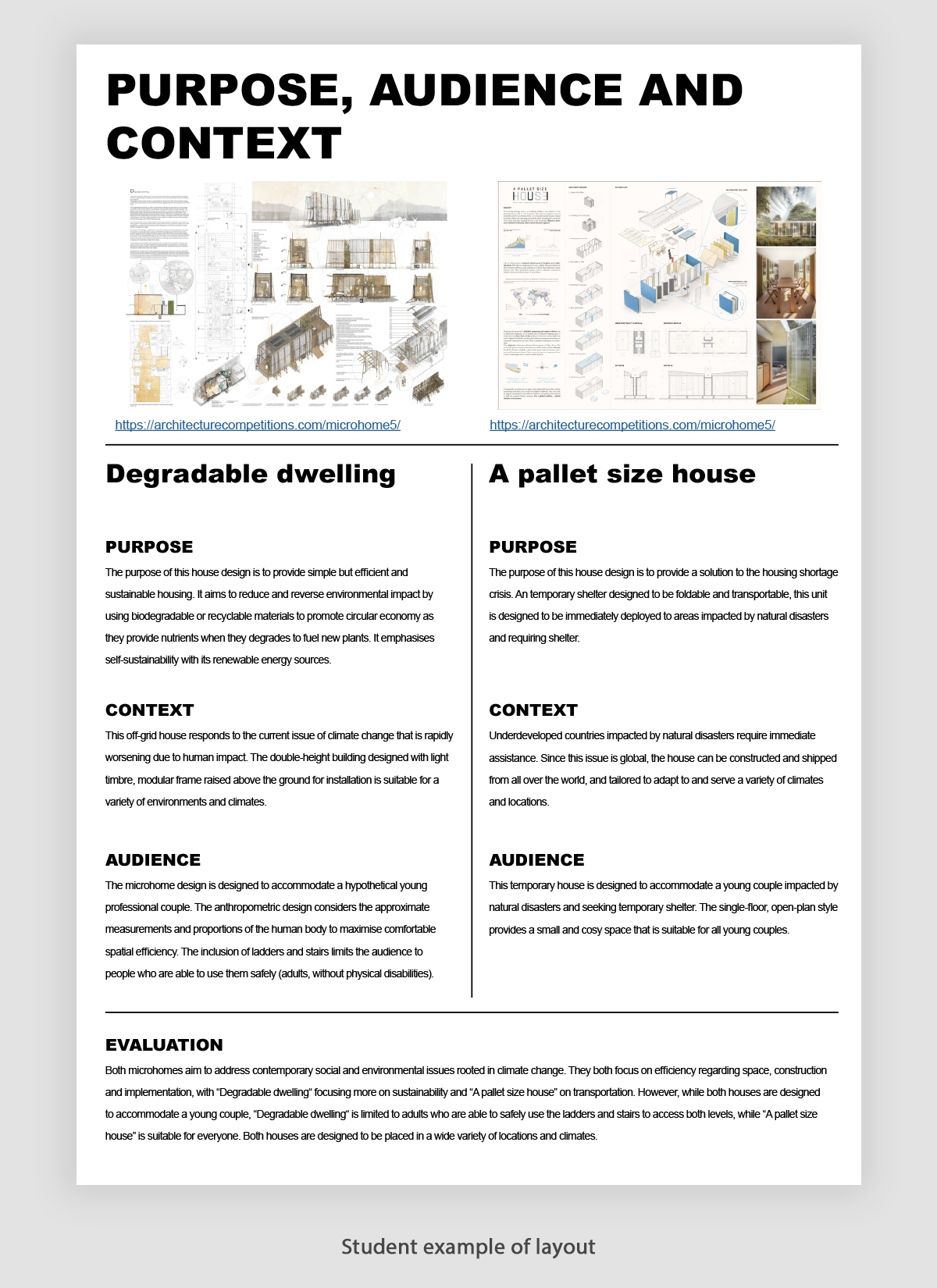
1. PURPOSE, CONTEXT & AUDIENCE
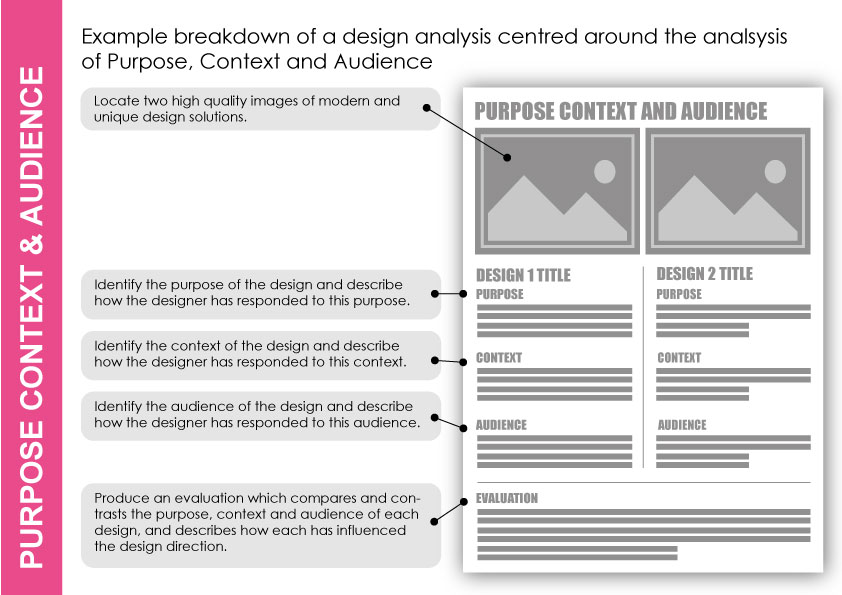
Students select and compare two design examples, describing each design’s purpose, context and audience or users.
The task focuses on how designers use visual language and aesthetic considerations to communicate ideas and information effectively.
Students analyse how design decisions respond to communication needs, including what the design is trying to achieve, who it is for, and the time and place in which it was produced and used.
Students finish with a short evaluation that compares and contrasts the two examples and explains how purpose, context and audience shaped each design direction.
CONNECTING TO THE STUDY DESIGN
This task directly supports Unit 3, Outcome 2 by developing students’ ability to compare and analyse design examples from selected field(s) of design practice.
Students describe the role of visual language in communication and analyse the relationship between aesthetic decisions and the purpose, context and audience or users of each design example.
The task reinforces appropriate Visual Communication Design terminology and builds foundations for later analysis of design elements and principles, methods, media and materials, and design factors.
These skills support SAC-ready comparative writing and help students justify evaluations using clear evidence from the design examples.
Getting started
Choose a field of design practice that interests you (message, object, environment or interactive experience design) and locate two high-quality examples that allow for meaningful comparison.
For each example, identify the design’s purpose (what it is trying to achieve), its context (where, when and why it exists), and its audience or users (who it is designed for and who may be affected).
Record key observations using the Purpose, Context and Audience framework, then collect evidence from the design that supports your claims, such as layout choices, imagery, type, materials, or interface features.
Write a short comparative evaluation explaining how differences in purpose, context and audience led to different design decisions and different communication outcomes.
Purpose, context and audience analysis of two design examples
| Task items | 1–2 (Very low) | 3–4 (Low) | 5–6 (Medium) | 7–8 (High) | 9–10 (Very high) |
|---|---|---|---|---|---|
|
Purpose Communication need and intention How the design responds |
Purpose is missing, incorrect, or unrelated to the design example. | Purpose is identified but is vague or mostly descriptive with little explanation. | Purpose is clearly identified and generally explained with some supporting evidence. | Purpose is clearly explained and linked to design decisions with relevant evidence. | Purpose is analysed insightfully, with precise evidence showing how design decisions support effective communication. |
|
Context Time, place and circumstances Influence on design decisions |
Context is not addressed or is inaccurate. | Context is mentioned but not clearly explained or linked to the design. | Context is explained with some relevant links to design decisions. | Context is clearly linked to specific design decisions and communication outcomes. | Context is analysed with strong cause-and-effect reasoning, showing how circumstances shaped aesthetic decisions. |
|
Audience or users Habits, mindsets and experiences How needs are addressed |
Audience/users are missing, incorrect, or generic (e.g. “everyone”). | Audience/users are identified but with limited detail or weak relevance to the design. | Audience/users are described with some detail and generally linked to design decisions. | Audience/users are described clearly (habits, mindsets, experiences) and linked to specific design decisions. | Audience/users are analysed perceptively, with strong evidence showing how design decisions target specific needs and behaviours. |
|
Comparison and evaluation Similarities and differences Judgement of effectiveness |
Little or no comparison; evaluation is missing or unsupported. | Some comparison, but mostly descriptive; evaluation is simple or not justified. | Clear comparison with relevant similarities/differences; evaluation is generally supported. | Strong comparison and evaluation, supported by clear evidence from both design examples. | Insightful comparative evaluation showing deep understanding of how purpose, context and audience shape effective communication. |
|
Use of terminology and written communication Appropriate VCD language Clarity and structure |
Writing is unclear; VCD terminology is absent or incorrect. | Writing is uneven; terminology is limited or occasionally inaccurate. | Writing is clear and structured; terminology is generally accurate. | Writing is well structured and uses accurate terminology consistently and effectively. | Writing is highly coherent and precise, using VCD terminology confidently to support a strong analysis. |
Key knowledge covered (Unit 3, Outcome 2 – Task 1)
| ✓ / ✗ | Key knowledge |
|---|---|
| ✓ | techniques for analysing and evaluating design examples from selected field(s) of design practice |
| ✓ | the role of visual language in communicating ideas and information |
| ✗ | aesthetic decisions made by designers, using the design elements and principles |
| ✓ | the relationships between aesthetic decisions and the purposes, contexts and audiences or users of design examples |
| ✗ | methods, media and materials used to create design examples |
| ✗ | the influence of technological, economic, cultural, social or environmental factors on design decisions |
| ✗ | conceptions of good design |
| ✓ | appropriate design terminology |
Key skills covered (Unit 3, Outcome 2 – Task 1)
| ✓ / ✗ | Key skills |
|---|---|
| ✓ | compare and analyse design examples from selected field(s) of design practice |
| ✓ | describe the role of visual language in communicating ideas and information |
| ✗ | analyse influences on aesthetic decisions made by designers |
| ✗ | analyse and evaluate applications of methods, media and materials, and design elements and principles in selected design examples |
| ✗ | use conceptions of good design to evaluate design examples |
| ✓ | use appropriate terminology during analysis and evaluation |
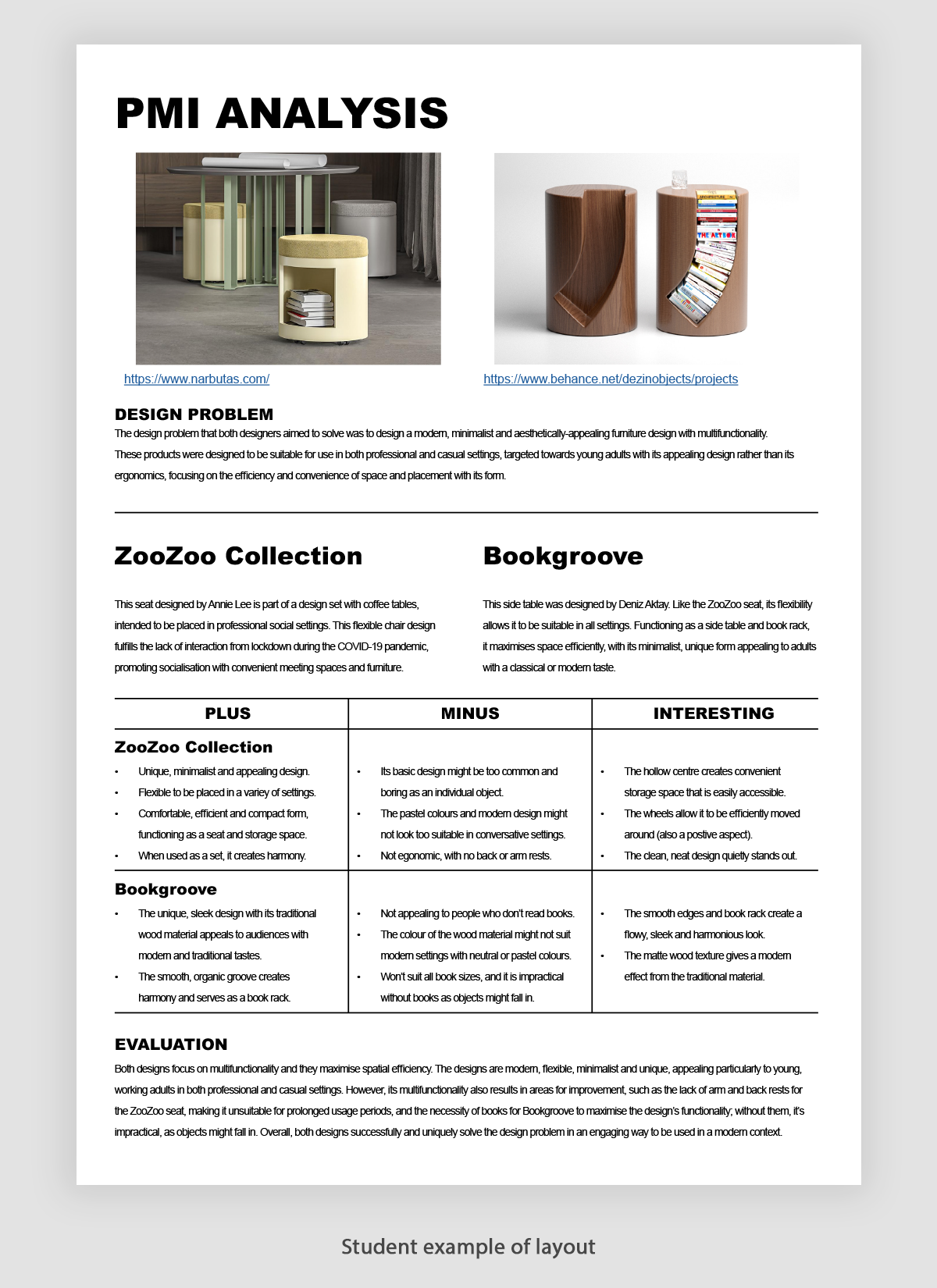
2. PMI EVALUATION
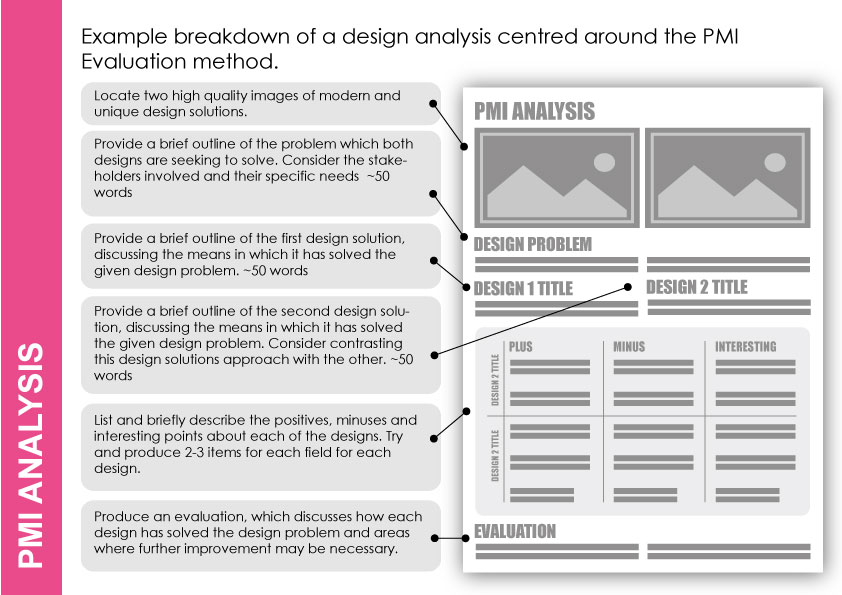
Students produce a PMI evaluation for two design examples, identifying the Plus, Minus and Interesting aspects of each design.
The task focuses on analysing and evaluating how effectively each design communicates ideas and information to its intended audience or users.
Students make supported judgements by referring to visible evidence in the design examples, such as layout, imagery, type, hierarchy, materials, or interface features.
Students finish with a brief comparative judgement, explaining which design is more effective for its purpose and why.
CONNECTING TO THE STUDY DESIGN
This task directly supports Unit 3, Outcome 2 by developing techniques for analysing and evaluating design examples from selected field(s) of design practice.
Students compare and analyse how visual language communicates meaning, and evaluate how aesthetic decisions contribute to effective communication of information or ideas.
The PMI structure supports clear, evidence-based evaluation and prepares students for SAC and exam writing that requires supported judgement using appropriate terminology.
Getting started
Select two design examples from a chosen field of design practice (message, object, environment or interactive experience design) that address a similar communication need.
Begin by briefly describing the design problem or communication need and the intended audience or users, then use the PMI table to record 2–3 points for each category: Plus, Minus and Interesting.
For each PMI point, include evidence from the design example (what you can see) and link it to effectiveness (how it helps or limits communication).
Finish with a short comparative paragraph using linking language such as similarly, in contrast, however and this results in to justify which design communicates more effectively.
PMI evaluation of two design examples
| Task items | 1–2 (Very low) | 3–4 (Low) | 5–6 (Medium) | 7–8 (High) | 9–10 (Very high) |
|---|---|---|---|---|---|
|
Plus (strengths) What works well Evidence linked to communication effectiveness |
Plus points are missing, incorrect, or not linked to the design example. | Some plus points, but mostly vague or descriptive with limited evidence. | Clear plus points with generally relevant evidence and links to effectiveness. | Strong plus points supported by clear evidence and explained impact on communication. | Insightful strengths analysis with precise evidence and clear justification of communication effectiveness. |
|
Minus (limitations) What reduces effectiveness Opportunities for improvement |
Minus points are missing, incorrect, or unsupported. | Some minus points, but they are vague, unfair, or not linked to evidence. | Clear limitations identified with some evidence and relevance to effectiveness. | Strong limitations analysis with clear evidence and realistic improvement ideas. | Perceptive analysis of limitations with precise evidence and thoughtful, design-informed improvement suggestions. |
|
Interesting (insights) What stands out or raises questions Broader implications or interpretation |
Interesting points are missing or irrelevant. | Interesting points are basic or superficial, with limited explanation. | Interesting points are relevant and explained with some evidence or insight. | Interesting points show clear insight and are supported by evidence from the design. | Sophisticated insights that consider interpretation, implications and audience response, supported by strong evidence. |
|
Comparison and evaluation Similarities and differences across PMI Supported judgement of effectiveness |
Little or no comparison; evaluation is missing or unsupported. | Some comparison, but mostly descriptive; evaluation is simple or unclear. | Clear comparison with a generally supported judgement. | Strong comparison and evaluation, supported by evidence across both designs. | Insightful comparative evaluation showing deep understanding of effectiveness in relation to purpose and audience/users. |
|
Use of terminology and written communication Appropriate VCD language Clarity, structure and accuracy |
Writing is unclear; terminology is absent or incorrect. | Writing is uneven; terminology is limited or sometimes inaccurate. | Writing is clear and structured; terminology is generally accurate. | Writing is well structured and uses accurate terminology consistently and effectively. | Writing is highly coherent and precise, using VCD terminology confidently to justify analysis and evaluation. |
Key knowledge covered (Unit 3, Outcome 2 – Task 2)
| ✓ / ✗ | Key knowledge |
|---|---|
| ✓ | techniques for analysing and evaluating design examples from selected field(s) of design practice |
| ✓ | the role of visual language in communicating ideas and information |
| ✗ | aesthetic decisions made by designers, using the design elements and principles |
| ✗ | the relationships between aesthetic decisions and the purposes, contexts and audiences or users of design examples |
| ✗ | methods, media and materials used to create design examples |
| ✗ | the influence of technological, economic, cultural, social or environmental factors on design decisions |
| ✗ | conceptions of good design |
| ✓ | appropriate design terminology |
Key skills covered (Unit 3, Outcome 2 – Task 2)
| ✓ / ✗ | Key skills |
|---|---|
| ✓ | compare and analyse design examples from selected field(s) of design practice |
| ✓ | describe the role of visual language in communicating ideas and information |
| ✗ | analyse influences on aesthetic decisions made by designers |
| ✗ | analyse and evaluate applications of methods, media and materials, and design elements and principles in selected design examples |
| ✗ | use conceptions of good design to evaluate design examples |
| ✓ | use appropriate terminology during analysis and evaluation |
Example
Student PMI
Framework
PMI framework
3. CONCEPTIONS OF GOOD DESIGN
Students analyse and evaluate design examples using conceptions of good design.
Students select two design examples and apply one or more conceptions of good design (such as Dieter Rams’ principles or other recognised frameworks) to assess the quality and effectiveness of each design.
The task focuses on explaining how ideas of good design are reflected in aesthetic decisions, functionality, usability and communication.
Students conclude by comparing how successfully each design aligns with the selected conception(s) of good design.
CONNECTING TO THE STUDY DESIGN
This task directly supports Unit 3, Outcome 2 by requiring students to use conceptions of good design to analyse and evaluate design examples.
Students strengthen their understanding that good design is contextual, and that designers make considered decisions in response to purpose, audience or users, and context.
The task reinforces evaluative writing skills and supports higher-level examination responses that require judgement and justification.
Getting started
Begin by revisiting the idea that conceptions of good design are not fixed, and may be universal, cultural, personal or discipline-specific.
Introduce a clear framework, such as Dieter Rams’ Ten Principles for Good Design, and model how one principle can be applied to a real design example.
Students then select two design examples and identify which principles of good design are most relevant to each.
Finish by modelling a short evaluative paragraph explaining how effectively each design meets the selected conception(s) of good design, supported by visual evidence.
Evaluation of design examples using conceptions of good design
| Task items | 1–2 (Very low) | 3–4 (Low) | 5–6 (Medium) | 7–8 (High) | 9–10 (Very high) |
|---|---|---|---|---|---|
|
Understanding of good design Awareness that good design is contextual |
Shows little or no understanding of good design. | Basic or simplistic understanding of good design. | Demonstrates a general understanding of good design. | Clear understanding that good design is contextual. | Sophisticated understanding of good design with nuance and insight. |
|
Application of a conception of good design Use of a framework (e.g. Dieter Rams) |
Framework is not applied or is misused. | Framework applied superficially or inaccurately. | Framework applied accurately to some aspects. | Framework applied clearly and consistently. | Insightful and confident application of the framework. |
|
Use of visual evidence Specific references to design features |
Little or no visual evidence used. | Limited reference to visual features. | Clear reference to relevant visual features. | Strong use of specific visual evidence. | Highly specific and well-selected visual evidence. |
|
Evaluation and judgement Strengths, limitations and effectiveness |
Evaluation is absent or incorrect. | Limited evaluative comments. | Clear evaluation with some judgement. | Strong evaluation explaining effectiveness. | Insightful judgement with balanced strengths and limitations. |
|
Use of terminology and written communication Clarity, structure and accuracy |
Terminology is absent or inaccurate; writing unclear. | Limited terminology; structure is weak. | Uses appropriate terminology with generally clear writing. | Consistent, accurate terminology and clear structure. | Highly fluent writing using precise and confident VCD terminology. |
Key knowledge covered (Unit 3, Outcome 2 – Task 3: Conceptions of Good Design)
| ✓ / ✗ | Key knowledge |
|---|---|
| ✓ | contexts in which contemporary designers work |
| ✗ | practices and processes, including relevant methods, media, materials and conventions used by contemporary designers |
| ✓ | conceptions of good design in selected design field(s) of design practice |
| ✗ | differences between past, present and future professional design practices in selected field(s) of design practice |
| ✓ | distinguishing characteristics and the role of visual language in selected field(s) of design practice |
| ✗ | roles, relationships and responsibilities of designers, specialists and stakeholders when resolving design problems |
| ✓ | techniques used by designers to evaluate design ideas |
| ✓ | decisions made by designers during the resolution of design problems |
| ✗ | technological, economic, cultural, environmental and social factors influencing design practices |
| ✗ | ethical and legal obligations of designers |
| ✓ | appropriate design terminology |
Key skills covered (Unit 3, Outcome 2 – Task 3: Conceptions of Good Design)
| ✓ / ✗ | Key skills |
|---|---|
| ✗ | compare contexts in which contemporary designers work |
| ✗ | describe and compare past, present and future professional design practices in selected field(s) of design practice |
| ✓ | analyse and evaluate the characteristics and role of visual language in selected field(s) of design practice |
| ✗ | explain the roles of, and relationships between, designers, specialists and stakeholders when resolving design problems |
| ✓ | describe the techniques used by designers to evaluate design ideas |
| ✗ | explain the economic, technological, cultural, environmental and social factors that influence design practices |
| ✗ | identify and analyse design practices that acknowledge ethical and legal obligations |
| ✓ | use appropriate design terminology |
3. ELEMENTS & PRINCIPLES
Students analyse and compare how designers use design elements and design principles to communicate ideas and information.
Students select two design examples and describe how specific elements (such as colour, type, shape or tone) and principles (such as contrast, hierarchy or balance) are used individually and in combination.
The task focuses on explaining how these visual decisions support the design’s purpose and contribute to effective communication for the intended audience or users.
Students conclude with a comparative evaluation, identifying similarities and differences in how visual language is used across the two examples.
CONNECTING TO THE STUDY DESIGN
This task directly supports Unit 3, Outcome 2 by requiring students to analyse and evaluate aesthetic decisions made by designers using design elements and principles.
Students develop an understanding of how visual language communicates meaning and how design elements and principles are manipulated to achieve specific communication purposes.
The task reinforces accurate Visual Communication Design terminology and prepares students for SAC and examination questions that focus on visual language analysis.
Getting started
Select two design examples from a chosen field of design practice that allow clear discussion of design elements and principles.
Begin by identifying and annotating visible elements and principles in each design, focusing on how they guide attention, organise information and create emphasis.
Practise writing short analytical statements that link a design element and a design principle together (for example, how contrast in colour establishes hierarchy).
Finish by writing a comparative paragraph explaining which design uses elements and principles more effectively for its purpose and audience or users.
Elements and principles analysis of two design examples
| Task items | 1–2 (Very low) | 3–4 (Low) | 5–6 (Medium) | 7–8 (High) | 9–10 (Very high) |
|---|---|---|---|---|---|
|
Identification of elements and principles Accurate naming and selection Relevance to the design examples |
Elements/principles are mostly missing or incorrect. | Some correct terms, but choices are limited or not well matched to the designs. | Relevant elements and principles are identified with general accuracy. | Clear and accurate identification of relevant elements and principles for both designs. | Highly accurate, purposeful selection showing strong understanding of visual language. |
|
Analysis of visual language How elements and principles work Evidence from the designs |
Little or no analysis; mostly description or unsupported claims. | Basic description with limited explanation of how choices work. | Clear analysis with some evidence from the designs. | Strong analysis using clear evidence to explain how choices communicate meaning. | Insightful, detailed analysis showing how decisions shape attention, meaning and user/viewer experience. |
|
Linking to purpose, context and audience/users Communication effectiveness Cause-and-effect reasoning |
Links to purpose/context/audience are missing or inaccurate. | Some links are attempted but are vague or not supported by evidence. | Links are generally clear and supported with some reasoning. | Links are clearly explained, showing how choices support communication for the intended audience/users. | Highly convincing reasoning showing deep understanding of how visual language decisions meet communication needs. |
|
Comparison and evaluation Similarities and differences Supported judgement of effectiveness |
Little or no comparison; evaluation is missing or unsupported. | Some comparison, but mostly descriptive; judgement is unclear or weakly supported. | Clear comparison with a generally supported judgement. | Strong comparison and evaluation supported by evidence across both designs. | Insightful comparative evaluation demonstrating strong understanding of effective communication. |
|
Use of terminology and written communication Accurate VCD language Clarity and structure |
Writing is unclear; terminology is absent or incorrect. | Writing is uneven; terminology is limited or sometimes inaccurate. | Writing is clear and structured; terminology is generally accurate. | Writing is well structured and uses accurate terminology consistently and effectively. | Writing is highly coherent and precise, using terminology confidently to support analysis and evaluation. |
Key knowledge covered (Unit 3, Outcome 2 – Task 3)
| ✓ / ✗ | Key knowledge |
|---|---|
| ✓ | techniques for analysing and evaluating design examples from selected field(s) of design practice |
| ✓ | the role of visual language in communicating ideas and information |
| ✓ | aesthetic decisions made by designers, using the design elements and principles |
| ✓ | the relationships between aesthetic decisions and the purposes, contexts and audiences or users of design examples |
| ✗ | methods, media and materials used to create design examples |
| ✗ | the influence of technological, economic, cultural, social or environmental factors on design decisions |
| ✗ | conceptions of good design |
| ✓ | appropriate design terminology |
Key skills covered (Unit 3, Outcome 2 – Task 3)
| ✓ / ✗ | Key skills |
|---|---|
| ✓ | compare and analyse design examples from selected field(s) of design practice |
| ✓ | describe the role of visual language in communicating ideas and information |
| ✗ | analyse influences on aesthetic decisions made by designers |
| ✓ | analyse and evaluate applications of methods, media and materials, and design elements and principles in selected design examples |
| ✗ | use conceptions of good design to evaluate design examples |
| ✓ | use appropriate terminology during analysis and evaluation |
4. METHODS, MEDIA & MATERIALS
Students analyse and compare how methods, media and materials are used to create and communicate design solutions.
Students select two design examples that utilise different methods, media and materials, and describe how these choices influence both the aesthetic qualities and functional effectiveness of the designs.
The task requires students to explain why particular methods, media and materials were appropriate for the design’s purpose, context and audience or users.
Students conclude by evaluating how these production choices contribute to successful communication and overall design outcomes.
CONNECTING TO THE STUDY DESIGN
This task supports Unit 3, Outcome 2 by focusing on the analysis and evaluation of methods, media and materials used in professional design practice.
Students develop an understanding of how designers select and combine production approaches to maximise aesthetic impact and meet communication needs.
The task reinforces precise Visual Communication Design terminology and prepares students for written SAC and examination questions that require justification of design decisions.
Getting started
Begin by revisiting the distinctions between methods (doing words), media (tools and applications) and materials (surfaces or substrates).
As a class, annotate a sample design example, identifying the method used, the media involved and the material on or from which the design is produced.
Students then select two contrasting design examples and complete a comparison table outlining how methods, media and materials affect visual style, usability and communication.
Finish by modelling a short evaluative paragraph that explains why one combination of methods, media and materials is more effective for its intended purpose and audience.
Analysis of methods, media and materials in design examples
| Task items | 1–2 (Very low) | 3–4 (Low) | 5–6 (Medium) | 7–8 (High) | 9–10 (Very high) |
|---|---|---|---|---|---|
|
Identification of methods, media and materials Accuracy and clarity |
Methods, media and materials are incorrectly identified or missing. | Some correct identification with frequent confusion. | Methods, media and materials are mostly identified accurately. | Clear and accurate identification using correct terminology. | Precise, confident identification with clear distinctions between each. |
|
Explanation of aesthetic and functional impact How choices affect communication |
Little or no explanation of impact. | Basic explanation with limited relevance. | Clear explanation of how choices affect the design. | Strong explanation linking choices to aesthetics and function. | Insightful explanation showing cause-and-effect reasoning. |
|
Purpose, context and audience/users Appropriateness of production choices |
Links to purpose, context or audience are absent. | Limited or vague links made. | Clear links to purpose, context or audience/users. | Well-explained links showing appropriateness of choices. | Highly considered evaluation of suitability for context and users. |
|
Comparison between examples Similarities, differences and effectiveness |
No meaningful comparison. | Limited comparison; mostly descriptive. | Clear comparison with some evaluative comments. | Strong comparative analysis explaining effectiveness. | Insightful comparison with clear justification and judgement. |
|
Use of terminology and written communication Clarity, structure and accuracy |
Terminology is absent or inaccurate; writing unclear. | Limited terminology; structure is weak. | Uses appropriate terminology with generally clear writing. | Consistent, accurate terminology and clear structure. | Highly fluent writing using precise and confident VCD terminology. |
Key knowledge covered (Unit 3, Outcome 2 – Task 4)
| ✓ / ✗ | Key knowledge |
|---|---|
| ✓ | techniques for analysing and evaluating design examples from selected field(s) of design practice |
| ✓ | the role of visual language in communicating ideas and information |
| ✓ | aesthetic decisions made by designers, using the design elements and principles |
| ✓ | the relationships between aesthetic decisions and the purposes, contexts and audiences or users of design examples |
| ✓ | methods, media and materials used to create design examples |
| ✗ | the influence of technological, economic, cultural, social or environmental factors on design decisions |
| ✗ | conceptions of good design |
| ✓ | appropriate design terminology |
Key skills covered (Unit 3, Outcome 2 – Task 4)
| ✓ / ✗ | Key skills |
|---|---|
| ✓ | compare and analyse design examples from selected field(s) of design practice |
| ✓ | describe the role of visual language in communicating ideas and information |
| ✓ | analyse influences on aesthetic decisions made by designers |
| ✓ | analyse and evaluate applications of methods, media and materials, and design elements and principles in selected design examples |
| ✗ | use conceptions of good design to evaluate design examples |
| ✓ | use appropriate terminology during analysis and evaluation |
5. DESIGN FACTORS
Students analyse and evaluate how design factors influence aesthetic decisions and design outcomes.
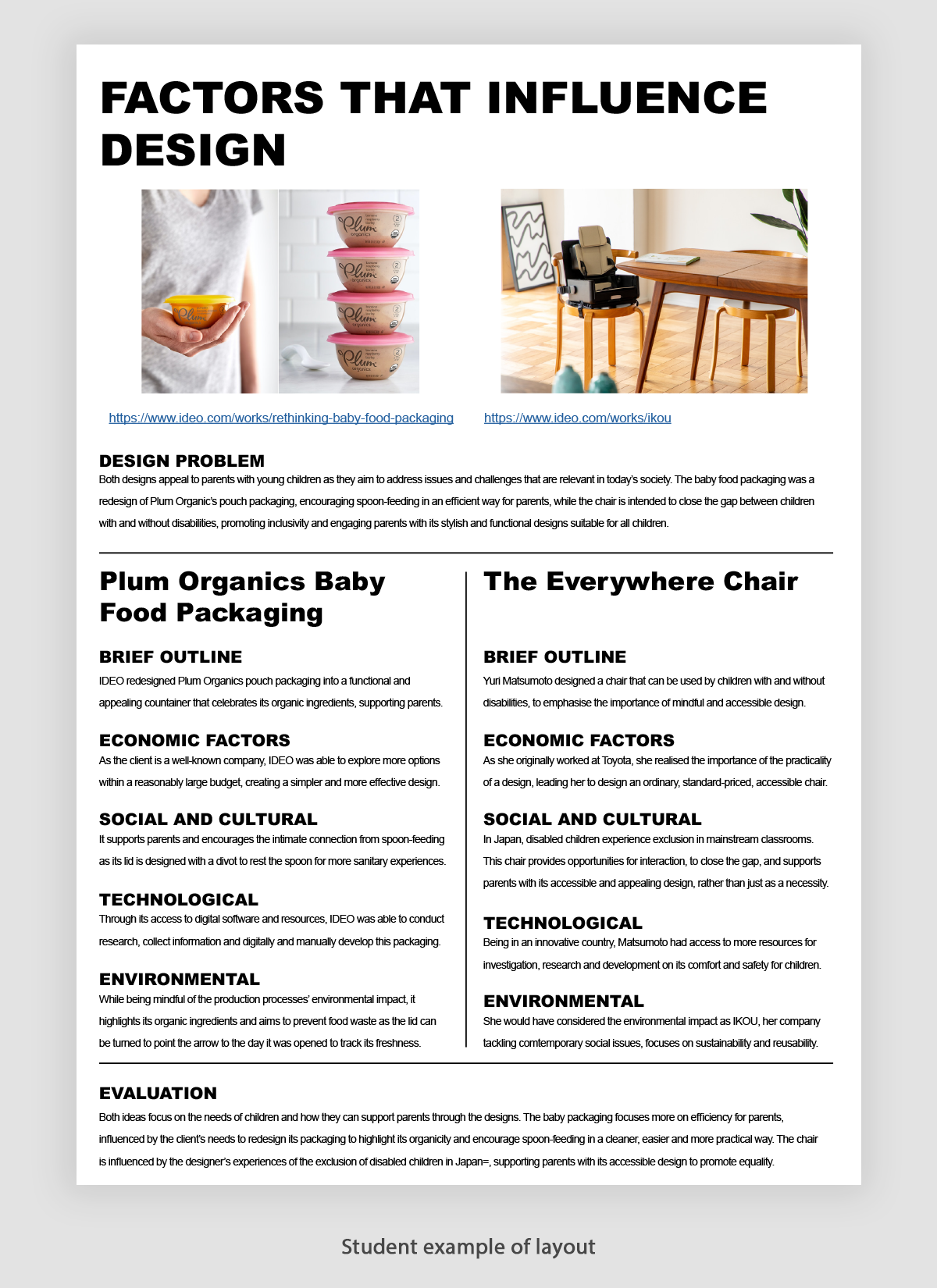
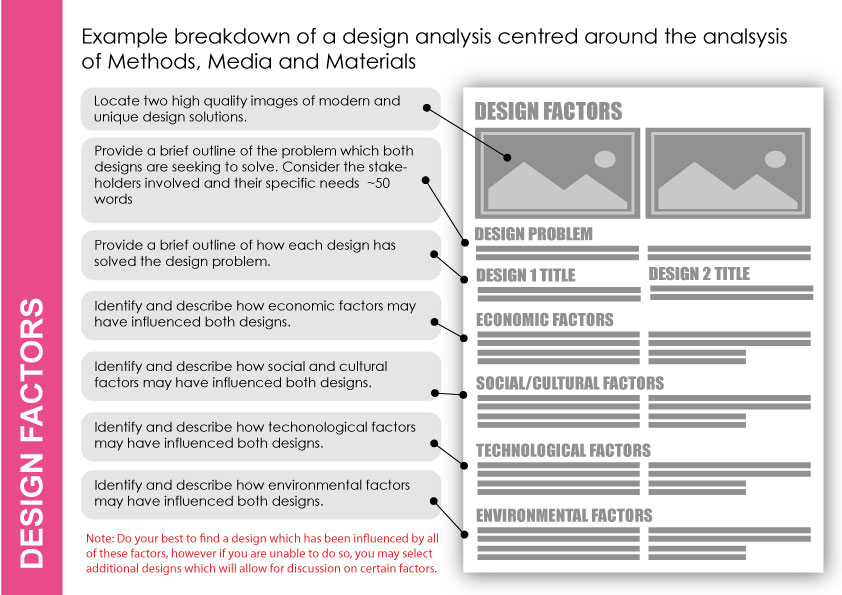
Students select two design examples and examine how economic, technological, cultural, social and environmental factors have shaped design decisions.
The task requires students to explain how these factors influence the way designers communicate ideas and information to audiences or users.
Students conclude by comparing the relative impact of different factors across the two examples, identifying which factors were most influential and why.
CONNECTING TO THE STUDY DESIGN
This task directly supports Unit 3, Outcome 2 by focusing on the influence of design factors on aesthetic decisions in professional design practice.
Students build their ability to analyse how external conditions shape design solutions, including constraints, opportunities and expectations placed on designers.
The task reinforces evaluative writing skills and prepares students for examination questions that require explanation of why design decisions were made.
Getting started
Begin by revisiting the five key design factors: economic, technological, cultural, social and environmental.
Analyse a shared design example as a class, mapping visible design decisions back to one or more influencing factors.
Students then select two design examples and identify at least three factors influencing each design, noting similarities and differences.
Finish by modelling a short evaluative paragraph explaining which factor had the greatest impact on each design and how this affected communication with the audience or users.
Analysis of design factors influencing design decisions
| Task items | 1–2 (Very low) | 3–4 (Low) | 5–6 (Medium) | 7–8 (High) | 9–10 (Very high) |
|---|---|---|---|---|---|
|
Identification of design factors Economic, technological, cultural, social, environmental |
Factors are missing or incorrectly identified. | One factor identified with limited accuracy. | Several factors identified accurately. | Factors are clearly and accurately identified. | Factors are precisely identified with strong understanding. |
|
Explanation of influence How factors shaped design decisions |
Little or no explanation of influence. | Basic explanation with weak links to decisions. | Clear explanation of how factors influenced decisions. | Strong explanation showing cause-and-effect reasoning. | Insightful, nuanced explanation of influence on design outcomes. |
|
Purpose, context and audience/users Relevance of factors to communication |
Links to purpose, context or audience are absent. | Limited or vague links made. | Clear links between factors and purpose or audience/users. | Well-explained links showing relevance to communication. | Highly considered evaluation of relevance and effectiveness. |
|
Comparison between examples Similarities, differences and relative impact |
No meaningful comparison. | Limited comparison; mostly descriptive. | Clear comparison with some evaluation. | Strong comparison explaining relative impact of factors. | Insightful comparison with clear judgement and justification. |
|
Use of terminology and written communication Clarity, structure and accuracy |
Terminology is absent or inaccurate; writing unclear. | Limited terminology; structure is weak. | Uses appropriate terminology with generally clear writing. | Consistent, accurate terminology and clear structure. | Highly fluent writing using precise and confident VCD terminology. |
Key knowledge covered (Unit 3, Outcome 2 – Task 5)
| ✓ / ✗ | Key knowledge |
|---|---|
| ✓ | techniques for analysing and evaluating design examples from selected field(s) of design practice |
| ✓ | the role of visual language in communicating ideas and information |
| ✗ | aesthetic decisions made by designers, using the design elements and principles |
| ✓ | the relationships between aesthetic decisions and the purposes, contexts and audiences or users of design examples |
| ✗ | methods, media and materials used to create design examples |
| ✓ | the influence of technological, economic, cultural, social or environmental factors on design decisions |
| ✗ | conceptions of good design |
| ✓ | appropriate design terminology |
Key skills covered (Unit 3, Outcome 2 – Task 5)
| ✓ / ✗ | Key skills |
|---|---|
| ✓ | compare and analyse design examples from selected field(s) of design practice |
| ✓ | describe the role of visual language in communicating ideas and information |
| ✓ | analyse influences on aesthetic decisions made by designers |
| ✗ | analyse and evaluate applications of methods, media and materials, and design elements and principles in selected design examples |
| ✗ | use conceptions of good design to evaluate design examples |
| ✓ | use appropriate terminology during analysis and evaluation |
WRITTEN SAC
Students complete a timed written assessment that brings together all key learning from Unit 3, Outcome 2.
Under test conditions, students analyse and evaluate design decisions using the frameworks practised across the outcome.
The task is completed without computers to ensure students can recall terminology, structure responses, and write clearly and accurately under exam-style conditions.
Students are assessed on their ability to apply design language to unfamiliar examples, explain why decisions were made, and justify evaluations with evidence from the visual material provided.
CONNECTING TO THE STUDY DESIGN
This task directly supports Unit 3, Outcome 2 by assessing students’ ability to analyse and evaluate design examples using appropriate terminology and structured reasoning.
Students demonstrate how designers’ decisions are shaped by purpose, audience and context, and by wider factors that influence design practice.
The SAC strengthens exam readiness by requiring students to select evidence, explain relationships between design decisions and communication needs, and write evaluative conclusions.
Getting started
This SAC runs for 90 minutes, with 15 minutes reading time. Use reading time to identify the task requirements, annotate the design examples, and plan your response structure.
Before the SAC, practise writing short responses by hand using each framework, focusing on clear topic sentences, correct terminology, and linking evidence to explanation.
Create a one-page handwritten revision sheet of key terms (design elements, design principles, Gestalt principles, methods, media, materials, and design factors) and test recall without notes.
In practice tasks, aim to write one strong evaluative paragraph that explains what decisions were made, why they were made (purpose/audience/context and factors), and how effective they are for the intended audience or users.
Written SAC rubric (Unit 3, Outcome 2)
| Task items | Low | Medium | High |
|---|---|---|---|
|
Q1 (6 marks) Discuss how two design principles have been used together effectively in the design example. |
Identifies one or two principles with errors or vague description. Limited evidence from the design example. Little connection to purpose, context or audience/users. Statements are mostly general. | Correctly identifies two principles and describes how they appear in the example. Uses some relevant evidence. Explains effectiveness with a basic link to purpose, context or audience/users. | Clearly explains how two principles work together (interaction + effect). Uses specific evidence (features, layout choices, hierarchy, spacing, colour, typography, etc.). Justifies effectiveness by linking to purpose, context and audience/users. |
|
Q2 (4 marks) Describe a design decision used within the design example to improve communication. |
Gives a vague or incorrect decision. Minimal description of how communication is improved. Limited or no use of design terminology. | Describes a relevant design decision with some detail. Explains how it helps communication in a basic way using some design terminology. | Clearly describes a specific decision and explains how it improves communication of ideas/information. Uses accurate visual language/design terminology and refers to clear evidence from the example. |
|
Q3 (8 marks) Evaluate how a factor has influenced the choice of a method, media or material in the design example. |
Identifies a factor and MMM with limited accuracy. Explanation is mostly descriptive or unclear. Little evaluation (no clear judgement of impact/effectiveness). | Identifies a relevant factor and links it to the choice of method, media or material. Provides a clear explanation with some evaluation (simple judgement + partial justification). | Provides a strong cause-and-effect evaluation: factor → constraints/opportunities → MMM choice → impact on outcome/communication. Uses specific evidence and includes a clear, justified judgement about how/why the factor influenced decisions. |
|
Q4 (8 marks) Part A: Discuss how the audience influenced design decisions. Part B: Discuss how the purpose influenced design decisions. |
Audience and/or purpose are unclear, generic, or not linked to decisions. Limited evidence from the example. Discussion is mostly descriptive. | Audience and purpose are described accurately. Explains some design decisions influenced by each, with relevant evidence. Links to aesthetic decisions are present but may be uneven across A/B. | Strong, evidence-based discussion for both parts: clearly states audience/purpose, identifies relevant design decisions, and explains why those decisions suit communication needs. Uses accurate terminology and clear reasoning. |
|
Q5 (10 marks) Compare how one design principle has been used functionally in the two selected design examples. |
Names a principle but comparison is limited or inaccurate. Mostly describes one example. Little functional reasoning (why it helps the design work). Minimal evidence. | Compares both examples with some balance. Explains functional use of the principle with evidence. Includes some similarities/differences and a basic judgement. | Detailed comparison using clear structure (similarities/differences + evidence from both). Explains functional purpose (how it supports communication/usability). Makes a clear judgement about relative effectiveness with strong justification. |
|
Q6 (6 marks) Discuss how an environmental factor has influenced the choice of materials in the selected design example. |
Environmental factor and materials are unclear or inaccurate. Limited explanation of influence. Little connection to the design outcome or communication needs. | Identifies a relevant environmental factor and materials used. Explains influence with some evidence and a basic link to outcome (e.g. sustainability, durability, waste, lifecycle). | Strong discussion showing clear links: environmental factor → material choice → implications for production/use/end-of-life → effect on the design solution. Uses evidence and accurate terminology. |
|
Q7 (6 marks) Discuss the materials used to produce the selected design example. |
Materials are missing, incorrect, or too general. Limited discussion of why they were selected or how they affect the design outcome. | Identifies key materials accurately and describes their role in the design. Provides some reasoning about suitability (function, durability, finish, cost, accessibility, etc.). | Thorough discussion of materials with clear links to function, aesthetics, production, and audience/users. Uses specific evidence from the design example and accurate VCD terminology. |
|
Q8 (8 marks) Part A: Describe how visual language communicates ideas/information. Part B: Explain links to aesthetic decisions and purpose/context/audience/users. |
Visual language features are vague or incorrect. Limited description and weak/no links to purpose/context/audience/users. Minimal evidence from the example. | Describes relevant visual language (type, colour, imagery, layout, hierarchy, etc.) with some evidence. Makes clear links to purpose/context/audience/users, though depth may vary between A/B. | Clear, detailed description supported by specific evidence. Strong explanation of how visual language choices (aesthetic decisions) communicate effectively for the intended purpose/context/audience/users. Uses precise terminology and logical structure. |
|
Q9 (10 marks) Evaluate how the designer has drawn on conceptions of good design to meet audience or user needs. |
Conceptions of good design are missing, incorrect, or listed without explanation. Limited evaluation and weak links to audience/user needs. Minimal evidence. | Uses at least one relevant conception of good design and explains it with some evidence. Evaluation includes a basic judgement about meeting audience/user needs. | Applies multiple relevant conceptions of good design (or one in depth) with strong evidence from the example. Provides a clear, justified evaluation of how well audience/user needs are met, including strengths and limitations where relevant. |
Key knowledge covered (Unit 3, Outcome 2 – Written SAC)
| ✓ / ✗ | Key knowledge |
|---|---|
| ✓ | techniques for analysing and evaluating design examples from selected field(s) of design practice |
| ✓ | the role of visual language in communicating ideas and information |
| ✓ | aesthetic decisions made by designers, using the design elements and principles |
| ✓ | the relationships between aesthetic decisions and the purposes, contexts and audiences or users of design examples |
| ✓ | methods, media and materials used to create design examples |
| ✓ | the influence of technological, economic, cultural, social or environmental factors on design decisions |
| ✓ | conceptions of good design |
| ✓ | appropriate design terminology |
Key skills covered (Unit 3, Outcome 2 – Written SAC)
| ✓ / ✗ | Key skills |
|---|---|
| ✓ | compare and analyse design examples from selected field(s) of design practice |
| ✓ | describe the role of visual language in communicating ideas and information |
| ✓ | analyse influences on aesthetic decisions made by designers |
| ✓ | analyse and evaluate applications of methods, media and materials, and design elements and principles in selected design examples |
| ✓ | use conceptions of good design to evaluate design examples |
| ✓ | use appropriate terminology during analysis and evaluation |