How do designers find and reframe human-centred design problems?
OUTCOME SUMMARY
Students use human-centred research and design thinking to identify, explore and reframe a complex design problem.
As the first outcome in VCE Visual Communication Design, this task introduces students to how designers find problems before solving them.
Students explore changing conceptions of good design and work collaboratively to investigate a human-centred issue affecting people, communities or societies.
Through divergent and convergent thinking, students apply ethical research methods to understand stakeholder perspectives, synthesise insights and define a clear communication need.
The outcome concludes with the preparation of a written brief, establishing purpose, audience, context and constraints to guide future design work.
OUTLINE
1. Mind Map Task
Explore a broad human-centred problem by mapping stakeholders, experiences and factors, establishing directions that guide quantitative, qualitative and design research.
2. Quantitative Research
Collect numerical data from stakeholders to identify patterns and trends, supporting insights that complement qualitative interviews and inform research decisions.
3. Qualitative Research
Gather rich perspectives through interviews or observations to understand stakeholder needs, deepening findings from surveys and shaping design research directions.
4. Design Research
Analyse existing designs, conventions and contexts to evaluate effectiveness, learning from precedent to refine understanding before defining a design brief.
5. Produce a Brief
Synthesise quantitative, qualitative and design research to clearly define the problem, audience, purpose and constraints that guide later design development.
1. MIND MAP TASK
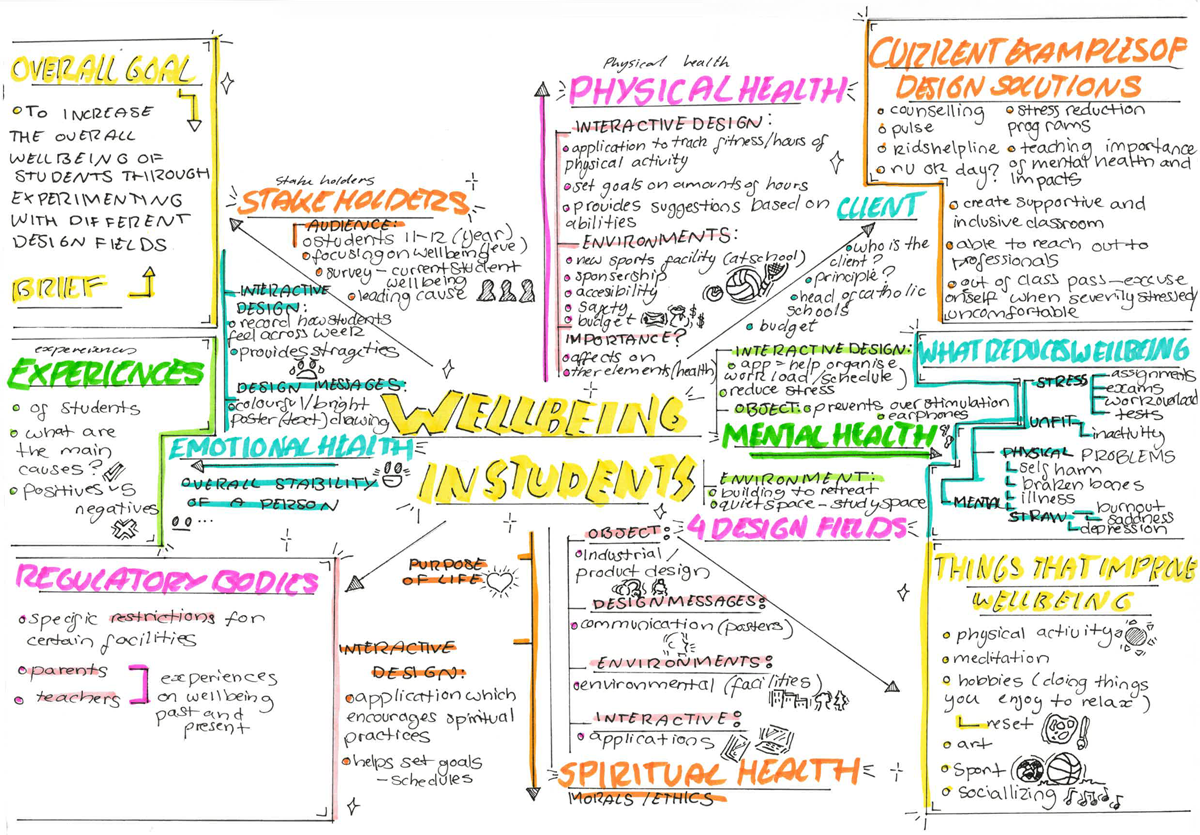
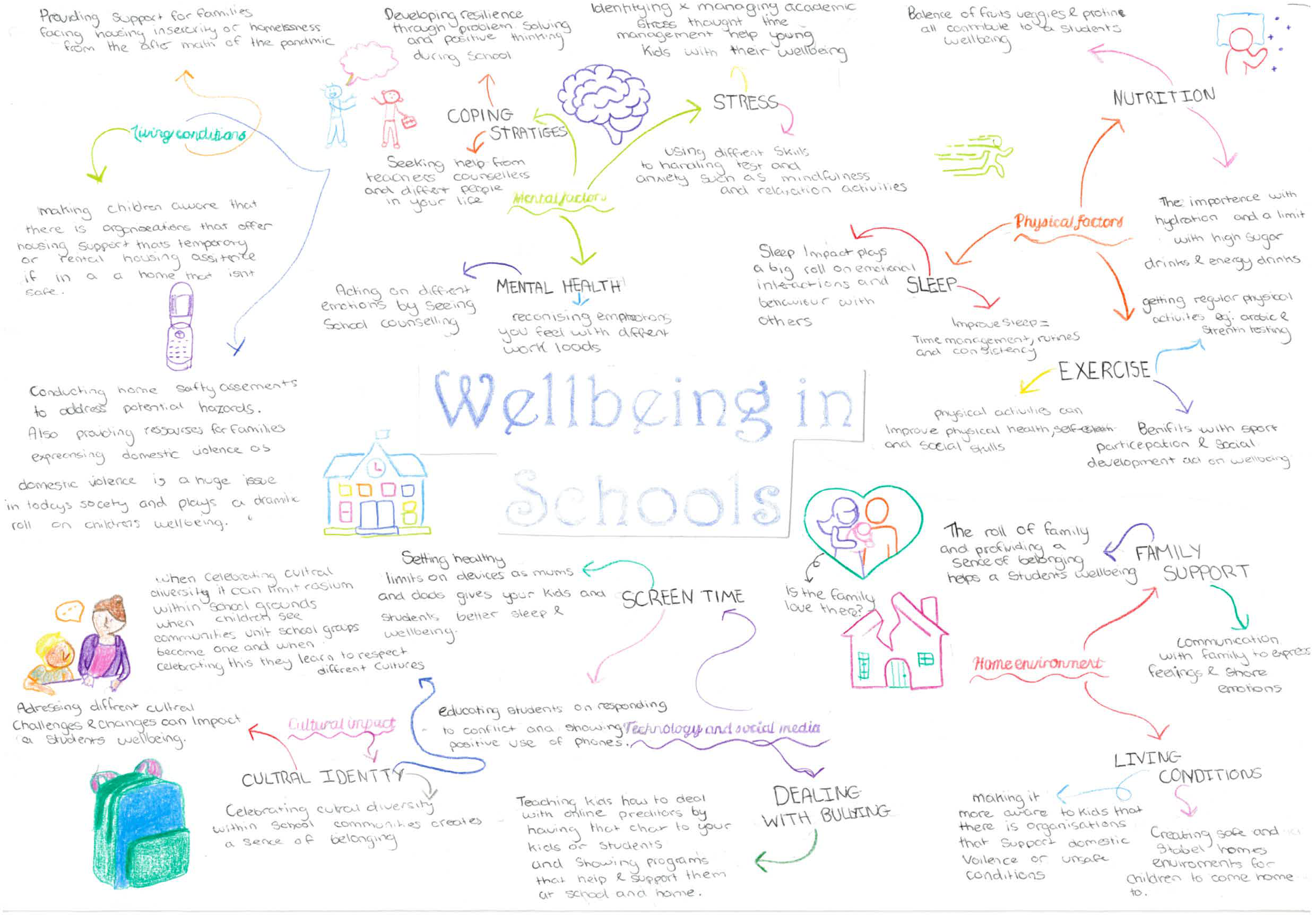
Students use divergent thinking to explore a broad, human-centred design problem through mind mapping.
Beginning with a context relevant to the cohort (for example, student wellbeing in schools), students visually map stakeholders, experiences, behaviours, needs and systems connected to the problem.
They consider how design may be used to improve life and living for people, communities or societies, without attempting to solve the problem at this stage.
The task prioritises curiosity, openness and exploration, helping students identify areas that require further investigation and research, including human-centred perspectives and factors that influence design decisions.
CONNECTING TO THE STUDY DESIGN
This task introduces the Discover phase of the VCD design process and establishes divergent thinking as a core design practice.
Students learn that designers begin by exploring problems broadly before defining communication needs.
The focus on stakeholders, lived experiences and influencing factors prepares students for later human-centred research methods, including surveys and interviews.
By visually mapping ideas, students also begin practising visual communication and design terminology, which they will use when presenting research findings and reframing design problems in subsequent parts of Outcome 1 and throughout the study.
Tips
Begin with a short discussion: “Where does design affect your experience at school?” Students write three examples individually, then share in pairs.
Introduce divergent thinking as a way of expanding ideas rather than narrowing them.
Model a simple mind map on the board using the selected design problem, showing branches for stakeholders, environments, emotions, behaviours and systems.
Students then work in small groups to create their own large-format mind maps using colour, symbols and keywords.
Reinforce that there are no correct answers at this stage and that ambiguity is expected in early design thinking.
Divergent thinking and mapping a human-centred design problem
| Task items | 1-2 (Very low) | 3-4 (Low) | 5-6 (Medium) | 7/8 (High) | 9/10 (Very high) |
|---|---|---|---|---|---|
|
Breadth of exploration Range of aspects mapped (stakeholders, needs, systems, experiences) Variety of angles and directions for further research |
Identifies very few aspects of the design problem. Mind map shows minimal branching and limited variety. |
Identifies some aspects of the design problem but with limited range. Mind map includes a few branches but remains narrow. |
Explores a range of relevant aspects of the design problem. Mind map shows clear branching with several meaningful areas to investigate. |
Explores the design problem from multiple perspectives. Mind map demonstrates strong breadth and identifies clear directions for further research. |
Demonstrates expansive and insightful exploration across many perspectives. Mind map identifies rich, layered directions for research and investigation. |
|
Human-centred focus Stakeholders, users, needs, behaviours and experiences Evidence of empathy and perspective-taking |
Little or no reference to people, users or stakeholders. Focus is mostly on the topic in general terms. |
Mentions people or stakeholders superficially. Limited detail about needs, behaviours or experiences. |
Identifies key stakeholders and some relevant needs or experiences. Shows basic understanding of who is affected and how. |
Clearly considers stakeholder needs, behaviours and experiences. Demonstrates empathy and a thoughtful human-centred perspective. |
Demonstrates strong empathy and nuanced understanding of multiple stakeholder perspectives. Shows insight into why the problem matters to different people. |
|
Consideration of design factors Social, cultural, environmental, economic and technological influences How context shapes the problem |
No relevant factors are identified. The problem is treated as if it exists without context. |
Identifies one factor vaguely or incorrectly. Limited connection to how the factor influences the problem. |
Identifies several relevant factors. Shows some understanding that context influences the problem. |
Explains how factors influence the design problem in meaningful ways. Links factors to stakeholder experiences or constraints. |
Integrates factors thoughtfully and insightfully. Shows strong understanding of how context shapes needs, constraints and opportunities for design. |
|
Visual organisation and clarity Use of structure, hierarchy, grouping and connections Mind map readability and communication |
Ideas are unclear or disorganised. Connections are difficult to follow. |
Limited visual structure and inconsistent organisation. Some ideas are readable but overall clarity is weak. |
Ideas are organised clearly with understandable branches. The mind map communicates the main thinking effectively. |
Visual organisation supports understanding through clear grouping and connections. Structure helps highlight priorities and research directions. |
Visual organisation enhances clarity and insight. Structure makes complex thinking easy to interpret and discuss. |
|
Use of design terminology Correct use of terms (stakeholders, audience/users, context, constraints, factors) Terminology supports meaning |
No design terminology is used. Language remains general or unclear. |
Limited terminology is used, or terms are used inaccurately. Meaning is sometimes confusing. |
Uses some correct terminology appropriately. Language generally supports the task. |
Uses accurate terminology appropriately and consistently. Terminology helps clarify thinking and discussion. |
Uses terminology confidently and precisely to support meaning. Language clearly communicates a human-centred, context-aware understanding of the problem. |
Key knowledge covered (Unit 1, Outcome 1 – Part 1)
| ✓ / ✗ | Key knowledge |
|---|---|
| ✗ | conceptions of good design across a range of design disciplines and contexts |
| ✗ | the role of visual language in producing good design outcomes |
| ✓ | the Discover and Define stages of the VCD design process |
| ✓ | techniques for effective collaboration in reframing human-centred design problems and identifying communication needs |
| ✗ | human-centred research methods including ethical design research practices |
| ✓ | strategies for convergent and divergent thinking |
| ✗ | techniques for the presentation of human-centred research findings |
| ✗ | the contents of a brief and its role in reframing ill-defined design problems |
| ✓ | design terminology used in research, analysis and evaluation |
Key skills covered (Unit 1, Outcome 1 – Part 1)
| ✓ / ✗ | Key skills |
|---|---|
| ✗ | identify and analyse past, present and personal conceptions of good design across various design fields |
| ✗ | formulate ideas about good design in future contexts |
| ✗ | use conceptions of good design to identify human-centred design problems |
| ✓ | collaborate with others to explore and reframe design problems using human-centred and ethical research methods |
| ✓ | apply the Discover and Define stages of the VCD design process |
| ✗ | present human-centred research findings |
| ✗ | compose a brief identifying a communication need |
| ✓ | use appropriate design terminology in research, analysis and evaluation |
2. QUANTITATIVE RESEARCH
Students design and conduct a quantitative research task to gather numerical data from stakeholders related to the design problem.
Using human-centred design thinking, students create a short survey aimed at understanding stakeholder needs, preferences and experiences, such as surveying students or parents and carers where appropriate.
Ethical research practices including anonymity, consent and respectful question design are considered throughout the process.
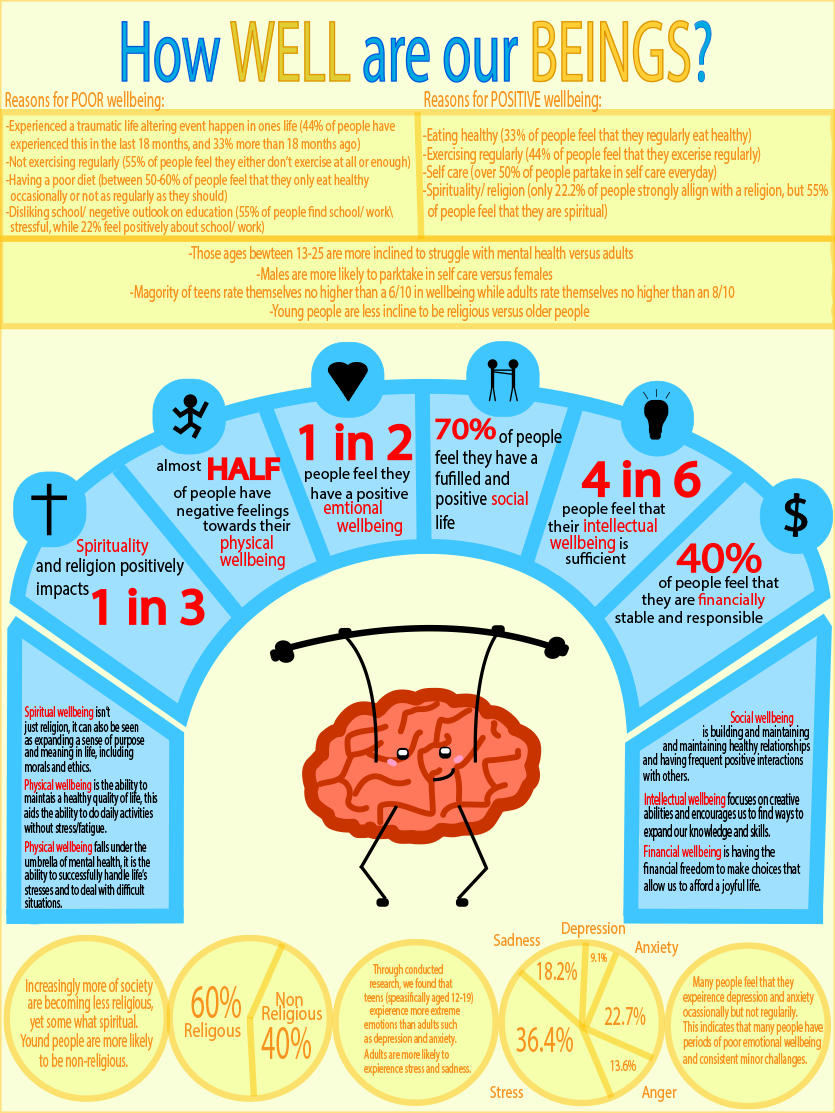
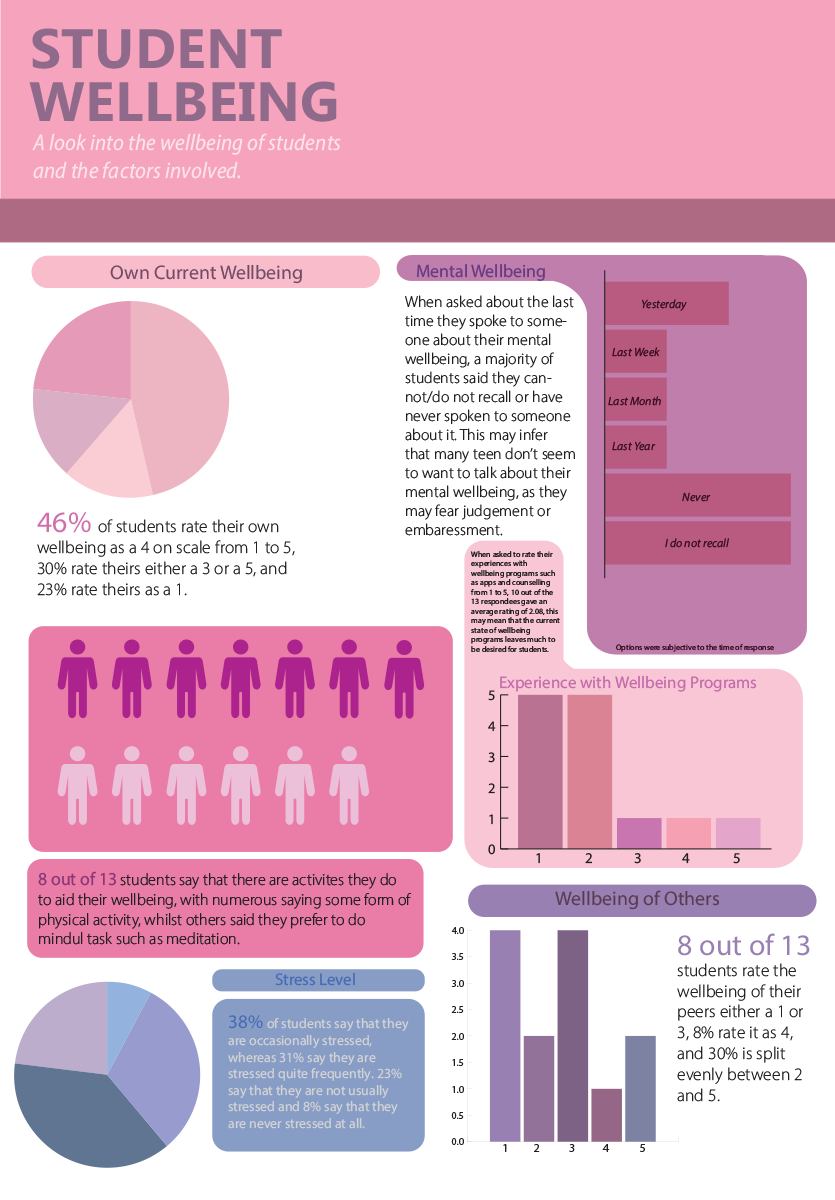
Students analyse the collected data and present their findings as an infographic, focusing on how visual language can clearly and effectively communicate information to an audience.
CONNECTING TO THE STUDY DESIGN
This task extends the Discover phase of the VCD design process by introducing formal human-centred research methods.
Students learn how quantitative data can reveal patterns and trends that help designers understand stakeholder needs and priorities.
By translating data into an infographic, students explore the role of visual language in producing effective communication, a key focus of Visual Communication Design.
The emphasis on ethical research practices reflects professional expectations of designers and prepares students for more complex research and justification tasks in later units, particularly Unit 3 and the School-assessed Task.
Tips
Begin by showing two contrasting infographics: one clear and well-designed, and one cluttered or misleading. Ask students which is easier to understand and why.
Introduce the idea that design decisions influence how information is interpreted, even when the data itself is accurate.
As a class, brainstorm what makes a survey question effective, ethical and unbiased. Model a strong and weak survey question on the board.
Students draft a small set of survey questions in pairs, refining wording to ensure clarity, relevance and respect for participants before finalising their survey.
Quantitative research and visualising stakeholder data
| Task items | 1-2 (Very low) | 3-4 (Low) | 5-6 (Medium) | 7/8 (High) | 9/10 (Very high) |
|---|---|---|---|---|---|
|
Survey design and relevance Quality and clarity of survey questions Alignment to the design problem |
Survey questions are unclear, irrelevant or incomplete. Questions show little connection to the design problem. |
Survey questions show limited clarity or relevance. Connection to the design problem is weak or inconsistent. |
Survey questions are mostly clear and relevant. Questions relate to the design problem in a general way. |
Survey questions are clear, purposeful and relevant. Questions are well aligned to understanding stakeholder needs. |
Survey questions are insightful, well-targeted and clearly aligned to the design problem. Questions demonstrate strong understanding of stakeholder needs. |
|
Ethical research practices Consideration of consent, anonymity and respectful data collection Responsibility to participants |
Ethical considerations are not addressed. Research practices may place participants at risk. |
Limited awareness of ethical considerations. Ethical practices are applied inconsistently. |
Basic ethical research practices are applied. Participants are treated respectfully. |
Ethical considerations are applied thoughtfully and appropriately. Research practices demonstrate care for participants. |
Ethical considerations are explicit, justified and consistently applied. Research practices reflect professional responsibility. |
|
Analysis of quantitative data Identification of patterns and trends Relevance of findings to the design problem |
Data is not analysed or is misinterpreted. No meaningful patterns are identified. |
Limited identification of patterns. Findings are described without explanation. |
Basic patterns and trends are identified. Findings show some relevance to the design problem. |
Patterns and trends are clearly identified and explained. Findings are linked to stakeholder needs. |
Data is analysed insightfully. Findings clearly inform understanding of the design problem and stakeholder priorities. |
|
Visual communication of information Clarity, hierarchy and readability of the infographic Use of visual language to communicate data |
Infographic is unclear or difficult to interpret. Visual choices obscure the information. |
Visual layout limits understanding. Some information is difficult to read or interpret. |
Visuals communicate information adequately. The infographic is mostly clear and readable. |
Visual language enhances clarity and understanding. Hierarchy and layout support communication of data. |
Visual language communicates data clearly, persuasively and effectively. Design choices significantly enhance understanding. |
|
Use of design terminology Correct use of terms (stakeholders, audience/users, context, visual language) Terminology supports explanation of decisions |
No design terminology is used. Language remains general or unclear. |
Limited terminology is used, or terms are used inaccurately. Meaning is sometimes confusing. |
Uses some correct terminology appropriately. Language generally supports the task. |
Uses accurate terminology appropriately and consistently. Terminology helps explain design decisions. |
Uses terminology confidently and precisely to justify visual and research decisions. Language clearly supports a human-centred, evidence-based understanding of the problem. |
Key knowledge covered (Unit 1, Outcome 1 – Part 2)
| ✓ / ✗ | Key knowledge |
|---|---|
| ✗ | conceptions of good design across a range of design disciplines and contexts |
| ✓ | the role of visual language in producing good design outcomes |
| ✓ | the Discover and Define stages of the VCD design process |
| ✓ | techniques for effective collaboration in reframing human-centred design problems and identifying communication needs |
| ✓ | human-centred research methods including ethical design research practices |
| ✗ | strategies for convergent and divergent thinking |
| ✓ | techniques for the presentation of human-centred research findings |
| ✗ | the contents of a brief and its role in reframing ill-defined design problems |
| ✓ | design terminology used in research, analysis and evaluation |
Key skills covered (Unit 1, Outcome 1 – Part 2)
| ✓ / ✗ | Key skills |
|---|---|
| ✗ | identify and analyse past, present and personal conceptions of good design across various design fields |
| ✗ | formulate ideas about good design in future contexts |
| ✗ | use conceptions of good design to identify human-centred design problems |
| ✓ | collaborate with others to explore and reframe design problems using human-centred and ethical research methods |
| ✓ | apply the Discover and Define stages of the VCD design process |
| ✓ | present human-centred research findings |
| ✗ | compose a brief identifying a communication need |
| ✓ | use appropriate design terminology in research, analysis and evaluation |
Example
Student example 1
Example
Student example 2
3. QUALITATIVE RESEARCH
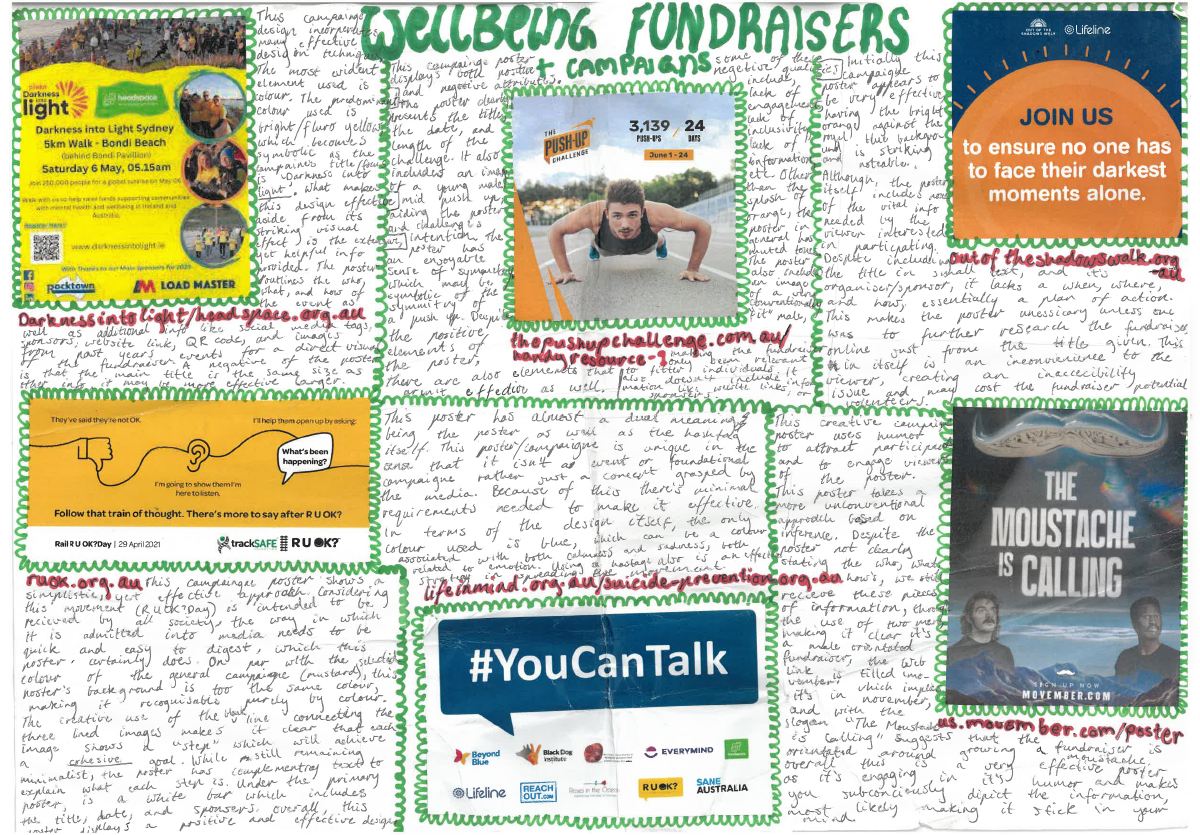
Students conduct short qualitative interviews to understand stakeholder opinions, experiences and priorities connected to the design problem.
In small groups, students plan and run a set of 5-minute interviews using open-ended questions that encourage detailed responses.
They record key points (without collecting personal or sensitive information) and synthesise results to identify themes, tensions and insights.
Students produce a written report including interview questions, a summary of findings, and an explanation of how insights clarify or reframe the design problem.
CONNECTING TO THE STUDY DESIGN
This task continues the Discover phase of the VCD design process by deepening understanding of stakeholder perspectives.
Where surveys reveal patterns, interviews uncover motivations, experiences and viewpoints that help designers build empathy and clarify what matters most.
Students practise ethical research methods and learn to synthesise findings into meaningful insights, supporting the reframing of ill-defined problems and preparing for Part 5 (writing a brief).
The written report contributes directly to Outcome 1 requirements by strengthening students’ ability to present research findings using appropriate design terminology.
Tips
Start with a quick modelling activity: run a 2-minute class interview using a volunteer and one open-ended question (for example, “What makes a school space feel welcoming?”).
Ask students what made the question effective or ineffective. Introduce the difference between open and closed questions, and discuss how wording can influence responses.
In pairs, students convert three closed questions into open-ended questions. Share examples and refine them together.
Briefly reinforce ethical research practices: no names, no personal disclosures, respectful tone, and the right to pass on a question.
Qualitative research interviews and synthesis
| Task items | 1-2 (Very low) | 3-4 (Low) | 5-6 (Medium) | 7/8 (High) | 9/10 (Very high) |
|---|---|---|---|---|---|
|
Interview question design Open-ended, relevant, unbiased questions Alignment to the design problem |
Questions are unclear, inappropriate or unrelated to the design problem. Questions do not support useful responses. |
Questions are basic and only loosely related to the design problem. Some questions lead or limit responses. |
Questions are mostly clear and relevant. Some open-ended questioning supports useful responses. |
Questions are clear, open-ended and purposeful. Questions support detailed responses about stakeholder needs and experiences. |
Questions are insightful, well-targeted and unbiased. Questions strongly support rich insights that clarify the design problem. |
|
Ethical and respectful research conduct Consent, anonymity, right to pass Professional interview behaviour |
Ethical considerations are not addressed. Interview conduct is inappropriate or disrespectful. |
Limited awareness of ethical practice. Interview conduct is inconsistent or overly casual. |
Basic ethical practices are applied. Interview conduct is generally respectful and appropriate. |
Ethical practice is applied thoughtfully. Interview conduct is respectful, organised and professional. |
Ethical practice is explicit, consistent and clearly managed. Interview conduct demonstrates strong professionalism and care for participants. |
|
Synthesis of findings Themes, patterns and stakeholder perspectives Links to the design problem |
Findings are unclear, incomplete or not synthesised. No meaningful themes are identified. |
Findings are listed with limited explanation. Themes are vague or weakly connected to the design problem. |
Key themes are identified. Some links are made between findings and the design problem. |
Themes are clearly synthesised and explained. Findings are linked to stakeholder needs and the design problem. |
Synthesis is insightful and clearly prioritised. Findings strongly clarify what matters most and how the problem could be reframed. |
|
Written report and presentation of findings Clear structure (questions, summary, insights) Communication for a teacher/client audience |
Report is unclear or missing key sections. Findings are difficult to follow. |
Report has limited structure or clarity. Some sections are incomplete or confusing. |
Report is organised and mostly clear. Findings are communicated adequately. |
Report is clear, well-structured and easy to interpret. Findings and insights are communicated effectively. |
Report is polished, concise and highly informative. Communication is strong and supports decision-making about the design problem. |
|
Use of design terminology Correct use of terms (stakeholders, audience/users, context, needs) Terminology supports explanation and evaluation |
No design terminology is used. Language remains general or unclear. |
Limited terminology is used, or terms are used inaccurately. Meaning is sometimes confusing. |
Uses some correct terminology appropriately. Language generally supports the report. |
Uses accurate terminology appropriately and consistently. Terminology supports clarity and justification. |
Uses terminology confidently and precisely to explain insights and implications. Language clearly supports a human-centred understanding of the problem. |
Key knowledge covered (Unit 1, Outcome 1 – Part 3)
| ✓ / ✗ | Key knowledge |
|---|---|
| ✗ | conceptions of good design across a range of design disciplines and contexts |
| ✗ | the role of visual language in producing good design outcomes |
| ✓ | the Discover and Define stages of the VCD design process |
| ✓ | techniques for effective collaboration in reframing human-centred design problems and identifying communication needs |
| ✓ | human-centred research methods including ethical design research practices |
| ✓ | strategies for convergent and divergent thinking |
| ✓ | techniques for the presentation of human-centred research findings |
| ✗ | the contents of a brief and its role in reframing ill-defined design problems |
| ✓ | design terminology used in research, analysis and evaluation |
Key skills covered (Unit 1, Outcome 1 – Part 3)
| ✓ / ✗ | Key skills |
|---|---|
| ✗ | identify and analyse past, present and personal conceptions of good design across various design fields |
| ✗ | formulate ideas about good design in future contexts |
| ✗ | use conceptions of good design to identify human-centred design problems |
| ✓ | collaborate with others to explore and reframe design problems using human-centred and ethical research methods |
| ✓ | apply the Discover and Define stages of the VCD design process |
| ✓ | present human-centred research findings |
| ✗ | compose a brief identifying a communication need |
| ✓ | use appropriate design terminology in research, analysis and evaluation |
4. DESIGN RESEARCH
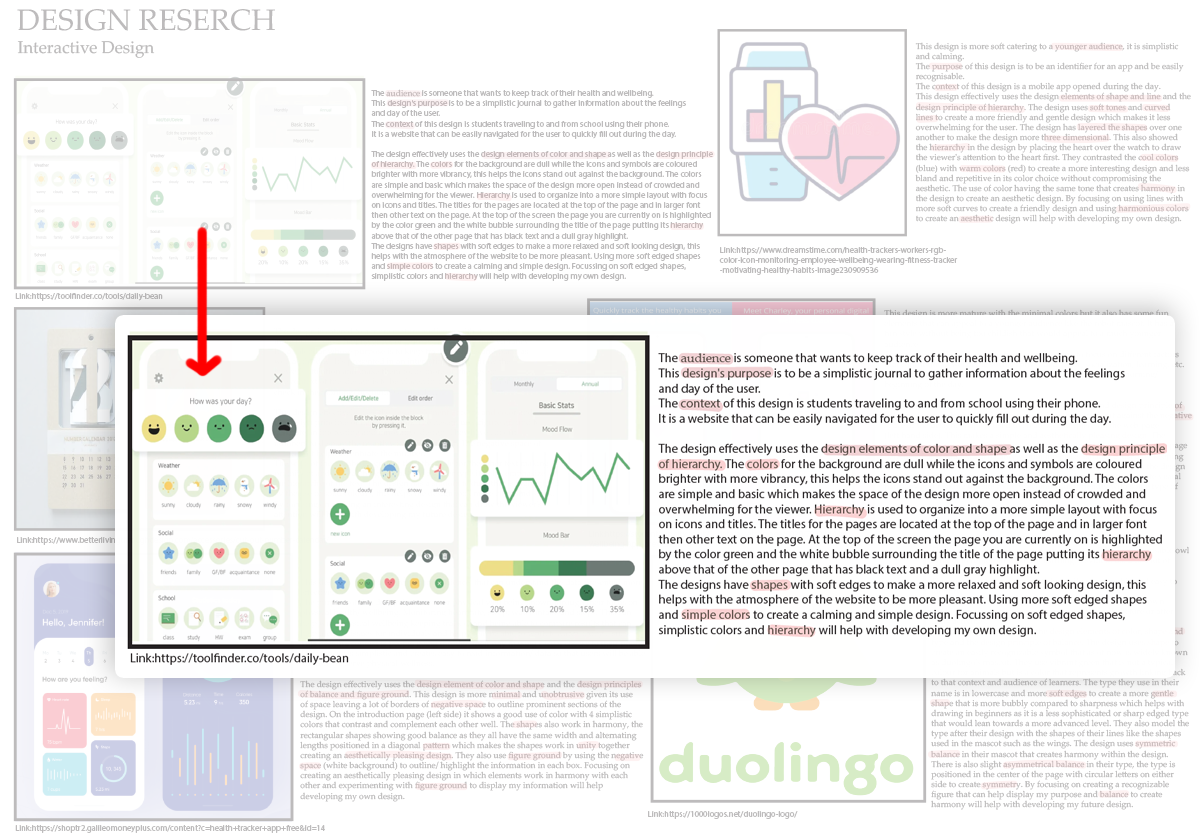
Students investigate existing designs that relate directly to their chosen design problem and evaluate how effectively they address human-centred needs.
They locate a range of relevant examples from an appropriate design field (such as message or object design) and analyse each example in relation to purpose, audience and context.
Students evaluate how well each example aligns with their emerging conceptions of good design, identifying strengths, limitations and opportunities for improvement.
Findings are documented using written annotations that explain what can be learned from each example, focusing on learning from precedent rather than copying solutions.
CONNECTING TO THE STUDY DESIGN
This task strengthens the Discover and Define phases of the VCD design process by showing students how designers learn from existing solutions.
Analysing design examples helps students refine their understanding of what constitutes good design in context, and how visual communication can influence behaviour and experience.
The task supports Outcome 1 by helping students reframe their design problem using informed insights rather than assumptions.
It also lays important groundwork for later units, where students will be expected to justify design decisions by referencing precedent and design practice.
Tips
Begin by presenting two contrasting design examples that address a similar problem, one more effective than the other. As a class, discuss which design works better and why.
Prompt students to move beyond personal opinion by asking: Who is this for? What problem is it trying to solve? In what context is it used?
Introduce or revisit a simple framework for analysing design examples (purpose, audience, context, effectiveness). Practise analysing one example together.
Students then complete independent research into designs connected to their own design problem, recording observations as written annotations.
Design research and evaluation of existing designs
| Task items | 1-2 (Very low) | 3-4 (Low) | 5-6 (Medium) | 7/8 (High) | 9/10 (Very high) |
|---|---|---|---|---|---|
|
Selection of design examples Relevance to the design problem Appropriateness of design field |
Examples are irrelevant or poorly chosen. Limited connection to the design problem. |
Examples show weak relevance. Connection to the design problem is unclear. |
Examples are generally relevant. Clear connection to the design problem. |
Examples are well selected and clearly relevant. Strong alignment to the design problem and field. |
Examples are highly relevant and thoughtfully selected. Clear insight into which designs are most useful to investigate. |
|
Analysis of purpose, audience and context Understanding who the design is for and why Awareness of context of use |
Purpose, audience and context are not identified. Analysis is minimal or inaccurate. |
Some aspects are identified but not explained. Limited understanding of context. |
Purpose, audience and context are identified clearly. Basic explanation is provided. |
Purpose, audience and context are analysed thoughtfully. Clear links to how the design is experienced. |
Analysis is detailed and insightful. Demonstrates strong understanding of how context and audience shape design decisions. |
|
Evaluation using conceptions of good design Human-centred effectiveness Strengths and limitations |
No evaluation is evident. Opinions are unsupported. |
Limited evaluation with little justification. Links to good design are vague. |
Basic evaluation of strengths and limitations. Some reference to good design principles. |
Clear evaluation supported by reasoning. Human-centred effectiveness is considered. |
Insightful evaluation clearly linked to conceptions of good design. Shows strong understanding of why the design is effective or ineffective. |
|
Use of research to inform the design problem Insights drawn from examples Contribution to reframing the problem |
No clear insights are identified. Research does not inform the design problem. |
Limited insights are identified. Weak connection to the design problem. |
Some useful insights are identified. Research begins to inform understanding of the problem. |
Research insights clearly inform the design problem. Connections are logical and useful. |
Research insights strongly inform and help reframe the design problem. Demonstrates clear learning from existing design practice. |
|
Use of design terminology Accurate and appropriate language Terminology supports evaluation |
No design terminology is used. Language is vague or unclear. |
Limited or inaccurate terminology. Meaning is sometimes unclear. |
Some correct terminology is used. Language generally supports evaluation. |
Accurate terminology is used consistently. Language clarifies analysis and evaluation. |
Terminology is used confidently and precisely. Language clearly supports professional-level evaluation. |
Key knowledge covered (Unit 1, Outcome 1 – Part 4)
| ✓ / ✗ | Key knowledge |
|---|---|
| ✓ | conceptions of good design across a range of design disciplines and contexts |
| ✓ | the role of visual language in producing good design outcomes |
| ✓ | the Discover and Define stages of the VCD design process |
| ✓ | techniques for effective collaboration in reframing human-centred design problems and identifying communication needs |
| ✗ | human-centred research methods including ethical design research practices |
| ✗ | strategies for convergent and divergent thinking |
| ✗ | techniques for the presentation of human-centred research findings |
| ✗ | the contents of a brief and its role in reframing ill-defined design problems |
| ✓ | design terminology used in research, analysis and evaluation |
Key skills covered (Unit 1, Outcome 1 – Part 4)
| ✓ / ✗ | Key skills |
|---|---|
| ✓ | identify and analyse past, present and personal conceptions of good design across various design fields |
| ✓ | formulate ideas about good design in future contexts |
| ✓ | use conceptions of good design to identify human-centred design problems |
| ✓ | collaborate with others to explore and reframe design problems using human-centred and ethical research methods |
| ✓ | apply the Discover and Define stages of the VCD design process |
| ✗ | present human-centred research findings |
| ✗ | compose a brief identifying a communication need |
| ✓ | use appropriate design terminology in research, analysis and evaluation |
5. PRODUCE A BRIEF
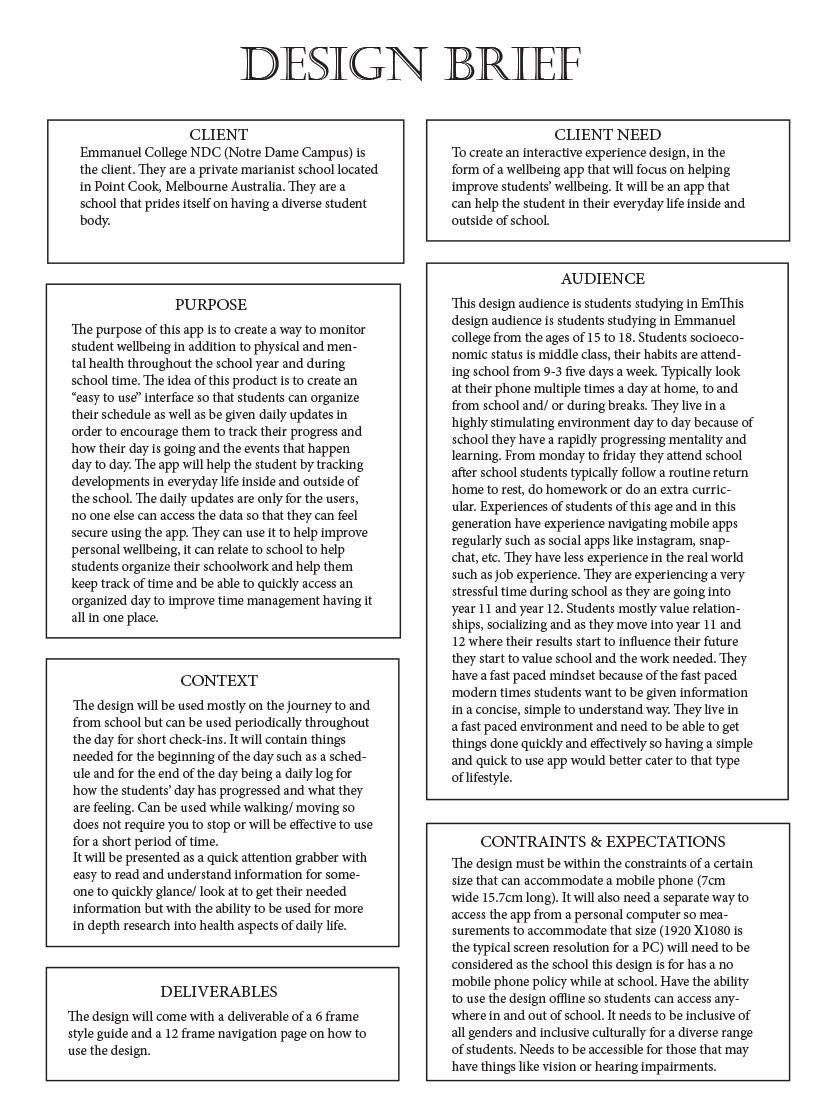
Students synthesise all research completed across Parts 1–4 to produce a clear, written design brief that defines a human-centred design problem.
The brief identifies a specific communication need and explains the purpose, audience or users, context and constraints of the problem.
Students draw directly on insights from quantitative research, qualitative interviews and design research to justify how the problem has been framed.
The emphasis is on clarity, focus and justification rather than proposing solutions, preparing students for later design development tasks.
CONNECTING TO THE STUDY DESIGN
This task completes the Define phase of the VCD design process and directly addresses the core requirement of Outcome 1.
Writing a brief requires students to move from divergent exploration to convergent decision-making, clarifying what the design problem is and what must be addressed.
The brief acts as a foundation for future design work, including visual language development and object or message design later in Unit 1.
This task mirrors professional design practice, where research-driven briefs guide design decisions and provide criteria for evaluating success.
Tips
Begin by showing students two example briefs: one vague and one clear and focused. Discuss which would be easier for a designer to respond to and why.
Highlight how strong briefs are specific, grounded in research and free from pre-determined solutions.
As a class, co-construct a checklist of what a brief should include (problem, purpose, audience, context, constraints).
Students map their own research findings into these categories before writing, helping them see how each research task contributes directly to the brief.
Synthesising research and writing a design brief
| Task items | 1-2 (Very low) | 3-4 (Low) | 5-6 (Medium) | 7/8 (High) | 9/10 (Very high) |
|---|---|---|---|---|---|
|
Identification of the design problem Clarity and focus of the problem Human-centred framing |
Design problem is unclear or missing. Problem is vague or solution-focused. |
Design problem is identified but poorly defined. Human-centred focus is limited. |
Design problem is clearly identified. Some evidence of human-centred thinking. |
Design problem is clearly articulated and human-centred. Focus reflects stakeholder needs. |
Design problem is precise, insightful and strongly human-centred. Framing clearly reflects research findings. |
|
Use of research to inform the brief Integration of quantitative, qualitative and design research Evidence-based decision making |
Research is not referenced or used. Decisions appear unsupported. |
Research is mentioned but weakly connected. Limited justification is provided. |
Research informs some aspects of the brief. Basic justification is evident. |
Research is clearly integrated throughout the brief. Decisions are justified using evidence. |
Research is synthesised insightfully. The brief demonstrates strong, evidence-based decision-making. |
|
Definition of purpose, audience and context Clarity of communication need Relevance to the design problem |
Purpose, audience or context are missing or unclear. Communication need is poorly defined. |
Purpose, audience and context are identified but vague. Communication need lacks focus. |
Purpose, audience and context are clearly identified. Communication need is understandable. |
Purpose, audience and context are clearly defined and relevant. Communication need is well articulated. |
Purpose, audience and context are precisely defined. Communication need is specific, focused and compelling. |
|
Identification of constraints Realistic and relevant limitations Awareness of practical considerations |
Constraints are not identified. Practical considerations are ignored. |
Constraints are listed but poorly explained. Limited relevance to the design problem. |
Relevant constraints are identified. Some explanation is provided. |
Constraints are clearly explained and realistic. Practical considerations are well considered. |
Constraints are insightful and clearly justified. Shows strong awareness of real-world design limitations. |
|
Use of design terminology and clarity of writing Professional tone and structure Communication for a client/designer audience |
Writing is unclear and lacks design terminology. Meaning is difficult to interpret. |
Limited use of terminology and inconsistent clarity. Writing lacks structure. |
Writing is mostly clear with some appropriate terminology. Structure supports understanding. |
Writing is clear, structured and uses accurate terminology. Tone is appropriate for a design brief. |
Writing is precise, professional and confident. Terminology and structure clearly support communication and evaluation. |
Key knowledge covered (Unit 1, Outcome 1 – Part 5)
| ✓ / ✗ | Key knowledge |
|---|---|
| ✓ | conceptions of good design across a range of design disciplines and contexts |
| ✗ | the role of visual language in producing good design outcomes |
| ✓ | the Discover and Define stages of the VCD design process |
| ✓ | techniques for effective collaboration in reframing human-centred design problems and identifying communication needs |
| ✓ | human-centred research methods including ethical design research practices |
| ✓ | strategies for convergent and divergent thinking |
| ✗ | techniques for the presentation of human-centred research findings |
| ✓ | the contents of a brief and its role in reframing ill-defined design problems |
| ✓ | design terminology used in research, analysis and evaluation |
Key skills covered (Unit 1, Outcome 1 – Part 5)
| ✓ / ✗ | Key skills |
|---|---|
| ✓ | identify and analyse past, present and personal conceptions of good design across various design fields |
| ✓ | formulate ideas about good design in future contexts |
| ✓ | use conceptions of good design to identify human-centred design problems |
| ✓ | collaborate with others to explore and reframe design problems using human-centred and ethical research methods |
| ✓ | apply the Discover and Define stages of the VCD design process |
| ✗ | present human-centred research findings |
| ✓ | compose a brief identifying a communication need |
| ✓ | use appropriate design terminology in research, analysis and evaluation |