What influences design, and what does design influence?
OUTCOME SUMMARY
Students investigate how design is influenced by social, cultural, environmental, economic and technological factors, and how design itself can influence behaviours, interactions, systems and outcomes.
In this outcome, students apply this understanding to the development of a sustainable three-dimensional object, drawing on circular design practices and considering the needs of audiences, users and the wider world.
Working through the Develop and Deliver stages of the VCD design process, students generate, refine and communicate ideas using manual drawing methods, annotations and appropriate design terminology.
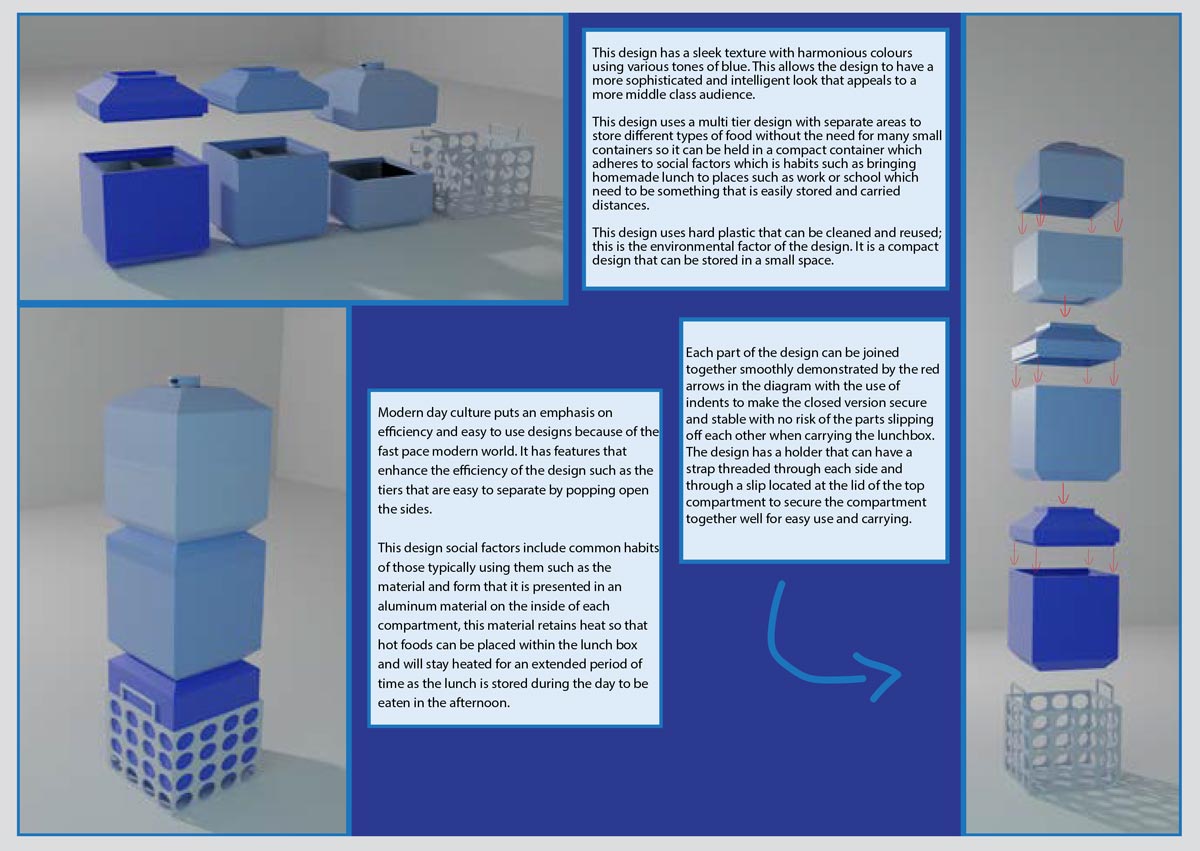
Across the sequence of tasks, students research existing object designs, develop and annotate ideas, experiment with design elements and principles, and resolve a final presentation of their design solution.
This outcome links directly to the study design by requiring students to analyse influences on design, adopt sustainable and circular design practices, and use visual language to develop and present a resolved object design.
OUTLINE
1. Research
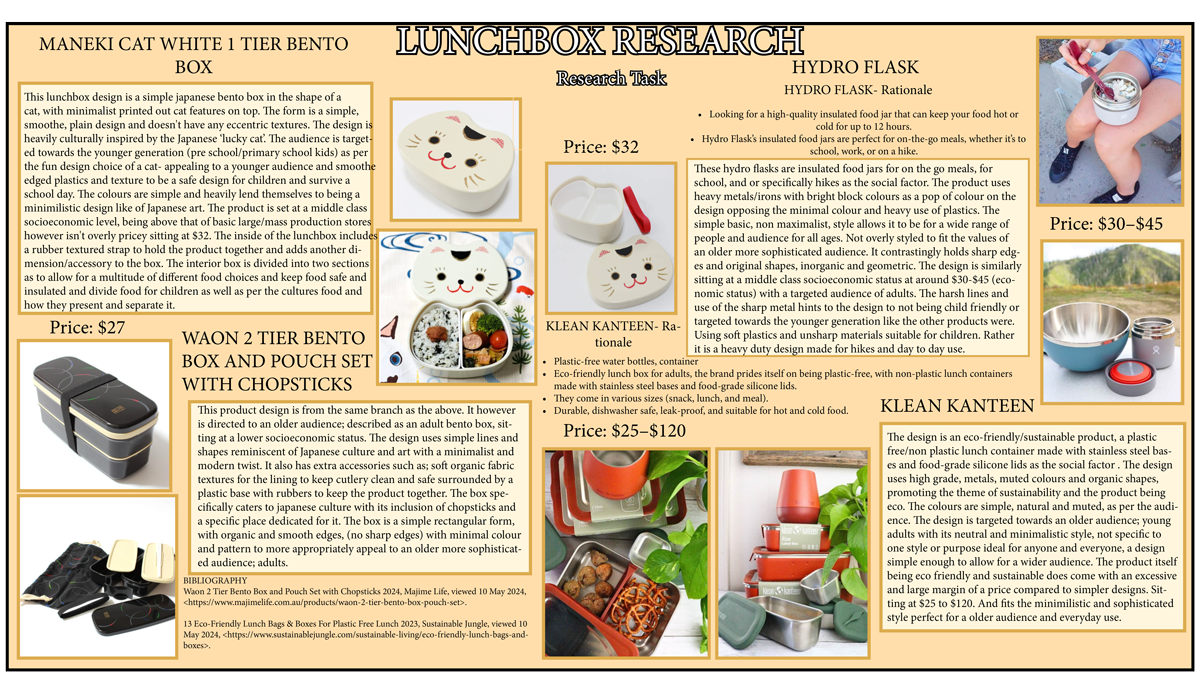
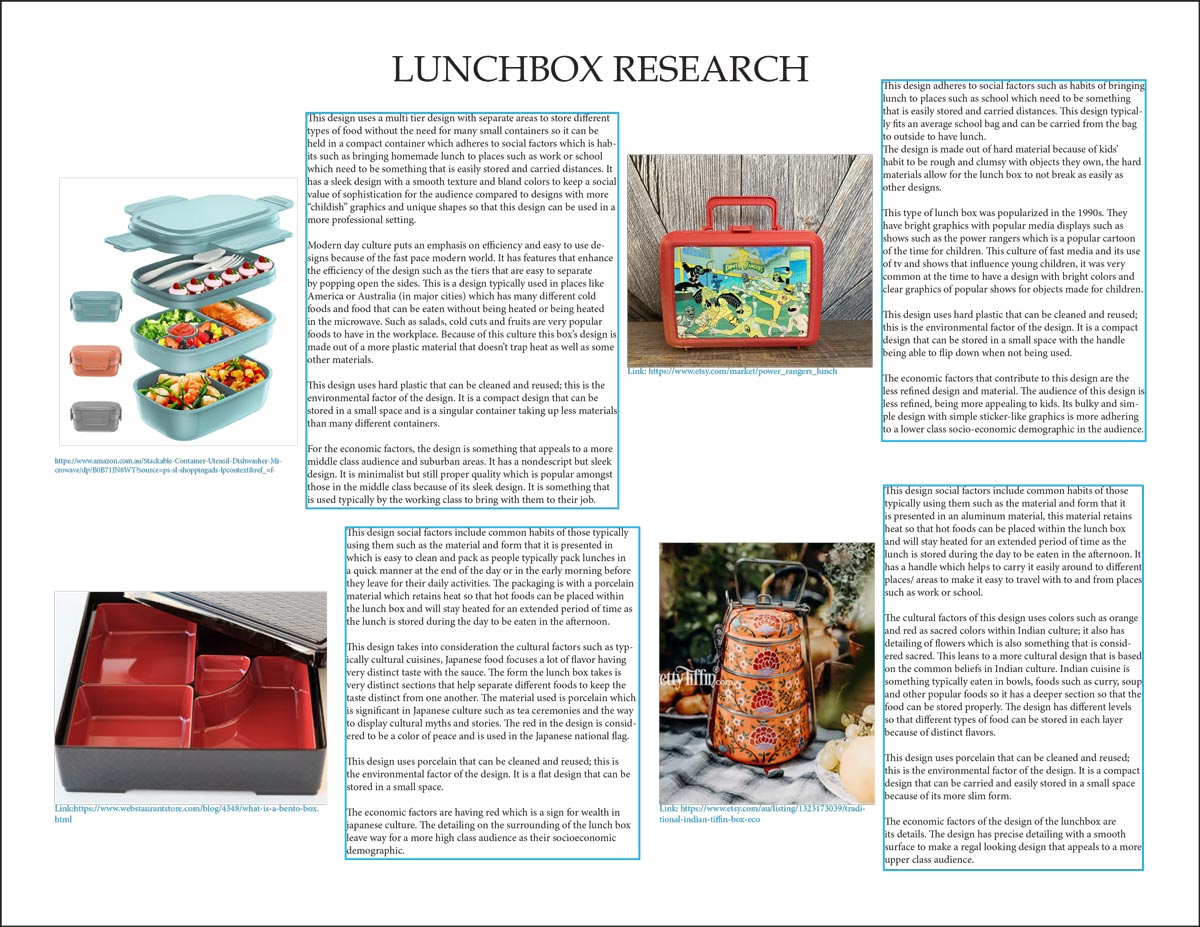
Investigate lunch box packaging from different places and time periods, analysing how social, cultural, environmental and economic factors have influenced materials, features and form.
2. Develop Ideas
Generate a range of annotated design ideas for a sustainable lunch box solution, showing how each concept responds to audience, purpose, context and circular design considerations.
3. Design Elements
Select one developed idea and modify it through focused experimentation with the design elements, using annotations to describe how visual changes affect the design.
4. Design Principles
Refine one developed idea through focused experimentation with the design principles, using annotations to explain how organisation and composition influence the design outcome.
5. Design Solution
Produce a resolved presentation board that communicates the final sustainable object design and explains how it responds to the factors and criteria established through the earlier tasks.
1. RESEARCH
Students investigate how different factors influence the design of objects by researching lunch box packaging from around the world and across different time periods.
Through the analysis of existing lunchbox designs, students explore how social habits, cultural traditions, environmental considerations and economic circumstances may influence the materials, features and form of an object.
Students evaluate a range of lunchboxes and identify how these factors have shaped the design decisions made by designers in different contexts.
This task helps students build an understanding of how design decisions are rarely made in isolation, but instead respond to the needs, behaviours and conditions of audiences and societies.
CONNECTING TO THE STUDY DESIGN
This task introduces the idea that design is influenced by a range of factors, including social, cultural, environmental and economic considerations.
By analysing past and present examples of object design, students begin to understand how designers respond to real-world conditions and constraints.
The activity aligns with the study design requirement for students to research and analyse influences on design and to develop an understanding of how these influences shape the materials, form and features of objects.
The research also informs later stages of the design process, helping students apply insights from existing designs when developing their own sustainable object solution.
Tips
Encourage students to look beyond appearance and consider why a lunchbox was designed in a particular way.
Students should consider who the lunchbox was designed for and how the habits of the user may influence the design.
Remind students to examine the materials used and whether environmental or sustainability considerations may have influenced these choices.
Students should aim to include examples from different cultures, time periods or economic contexts to demonstrate how design changes in response to different influences.
Clear layout, images and concise annotations will help communicate research effectively on the A3 page.
Researching influences on the design of lunch box packaging
| Task items | 1-2 (Very low) | 3-4 (Low) | 5-6 (Medium) | 7/8 (High) | 9/10 (Very high) |
|---|---|---|---|---|---|
|
Analysis of social factors Social habits, routines and behaviours How these influence the design of lunch box packaging |
Shows little or no understanding of social factors. Limited or no connection is made between social habits and the design. |
Identifies a social factor in a simple or unclear way. Explanation of its influence on the design is limited. |
Identifies relevant social factors and makes some connection to the design. Explanation shows a basic understanding of how habits or routines may influence features or form. |
Clearly explains how social factors influence the design of the lunch box. Links habits, routines or behaviours to materials, features or form in a meaningful way. |
Demonstrates a perceptive and well-developed understanding of social factors. Insightfully explains how social behaviours and routines shape design decisions across examples. |
|
Analysis of cultural factors Cultural practices, cuisines, beliefs and traditions How these influence the design of lunch box packaging |
Shows little or no understanding of cultural factors. Cultural influences are not identified or are irrelevant. |
Identifies a cultural factor in a limited or unclear way. Explanation of how culture influences the design is weak. |
Identifies relevant cultural factors and makes some connection to the design. Explanation shows a basic understanding of how culture may influence materials, features or form. |
Clearly explains how cultural factors influence the design of the lunch box. Links cultural practices or beliefs to design decisions in a purposeful way. |
Demonstrates a strong and thoughtful understanding of cultural factors. Insightfully explains how culture shapes design decisions across a range of examples. |
|
Analysis of environmental and economic factors Sustainability, material choice and socio-economic considerations How these influence the design of lunch box packaging |
Shows little or no understanding of environmental or economic factors. Makes no meaningful connection between these factors and the design. |
Identifies environmental or economic factors in a limited way. Explanation of their influence on the design is brief or unclear. |
Identifies relevant environmental and economic factors. Shows some understanding of how sustainability or cost may influence materials, features or form. |
Clearly explains how environmental and economic factors influence the design. Links sustainability and cost considerations to design decisions in a meaningful way. |
Demonstrates a perceptive understanding of environmental and economic influences. Insightfully explains how sustainability, waste, materials and market context shape design outcomes. |
|
Depth and range of research Selection of examples from different places and/or time periods Quality of evaluation across at least four lunchboxes |
Includes very few examples or examples are poorly chosen. Research is minimal and evaluation is largely absent. |
Includes some examples but with limited range or relevance. Evaluation is brief and descriptive rather than analytical. |
Includes a suitable range of examples. Evaluation shows some comparison and a basic understanding of influences on design. |
Includes a strong range of relevant examples from different contexts. Evaluation is clear and analytical, showing meaningful comparison between designs. |
Includes a highly effective and well-chosen range of examples. Evaluation is detailed, comparative and insightful, showing strong understanding of design across contexts. |
|
Visual organisation and communication Layout, clarity and readability of the A3 page Effective use of images, text and annotations |
Presentation is unclear or disorganised. Information is difficult to follow and visual communication is limited. |
Presentation shows limited organisation. Some information is readable, but layout or communication is inconsistent. |
Presentation is clear and organised. Images, text and annotations communicate the main ideas effectively. |
Presentation is visually effective and well organised. Layout supports understanding and makes the research easy to interpret. |
Presentation is highly polished, engaging and easy to follow. Visual organisation strengthens communication and enhances the quality of the research. |
Key knowledge covered (Unit 1, Outcome 3 – Task 1)
| ✓ / ✗ | Key knowledge |
|---|---|
| ✓ | influences on design such as economic, technological, cultural, environmental and social factors |
| ✓ | the influence of design on behaviours, interactions, systems and outcomes |
| ✓ | sustainable and circular design practices, and their value |
| ✗ | manual and digital methods, design elements and principles relevant to the design of three-dimensional objects |
| ✗ | rendering techniques used to simulate surfaces, materials, texture and form, and depict the direction of light, shade and shadow |
| ✗ | technical drawing conventions appropriate for the documentation of object designs |
| ✓ | appropriate design terminology |
Key skills covered (Unit 1, Outcome 3 – Task 1)
| ✓ / ✗ | Key skills |
|---|---|
| ✓ | research and analyse past and present influences on design |
| ✓ | research and analyse the influence of design in past and present contexts |
| ✗ | select and use appropriate manual and/or digital methods, media and materials to represent and render forms |
| ✗ | select appropriate design elements and principles when developing a sustainable object |
| ✗ | adopt circular design practices during the Develop and Deliver stages of the VCD design process |
| ✓ | annotate design ideas and concepts using design terminology |
| ✗ | apply two-dimensional drawing methods, such as technical flats or third-angle orthogonal projections, to depict objects from multiple views |
| ✗ | apply three-dimensional drawing methods, such as isometric or perspective drawing, to represent the form and structure of objects |
| ✗ | apply appropriate technical drawing conventions to documentation drawings |
2. DEVELOP IDEAS
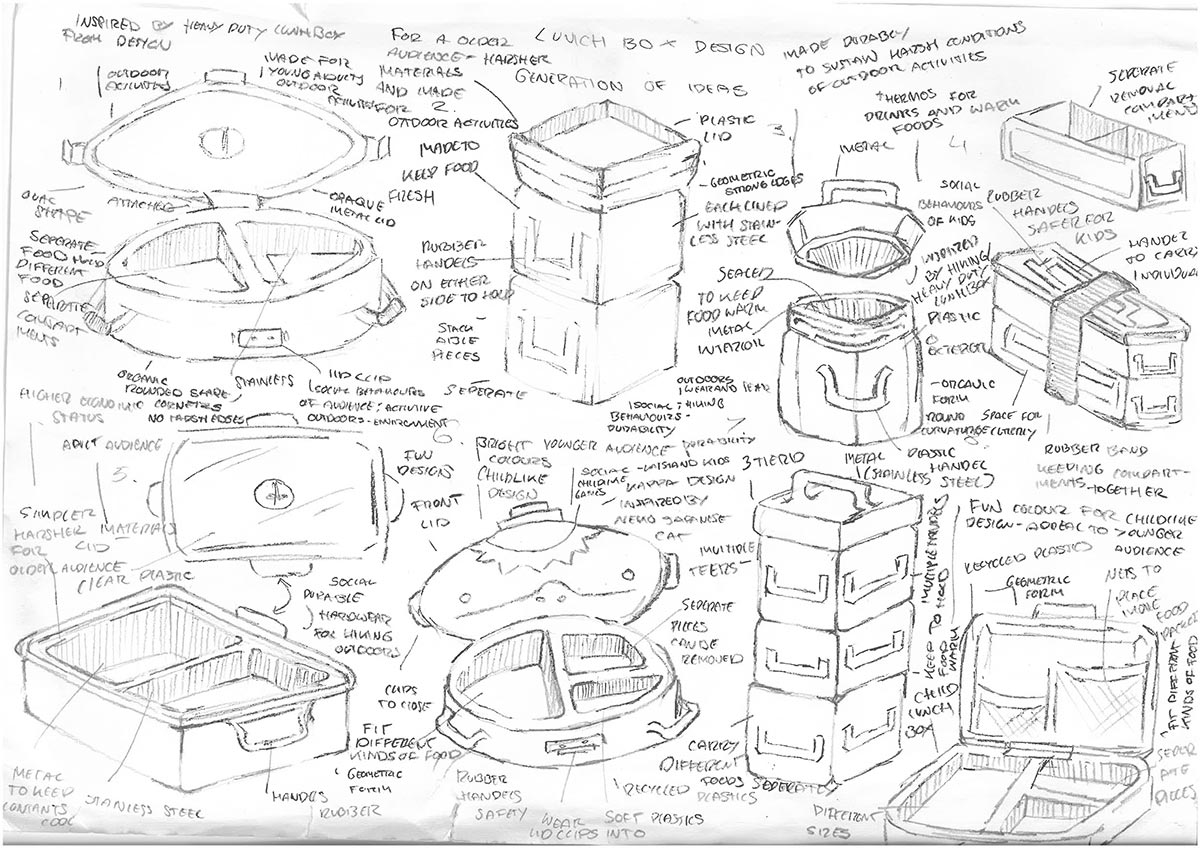
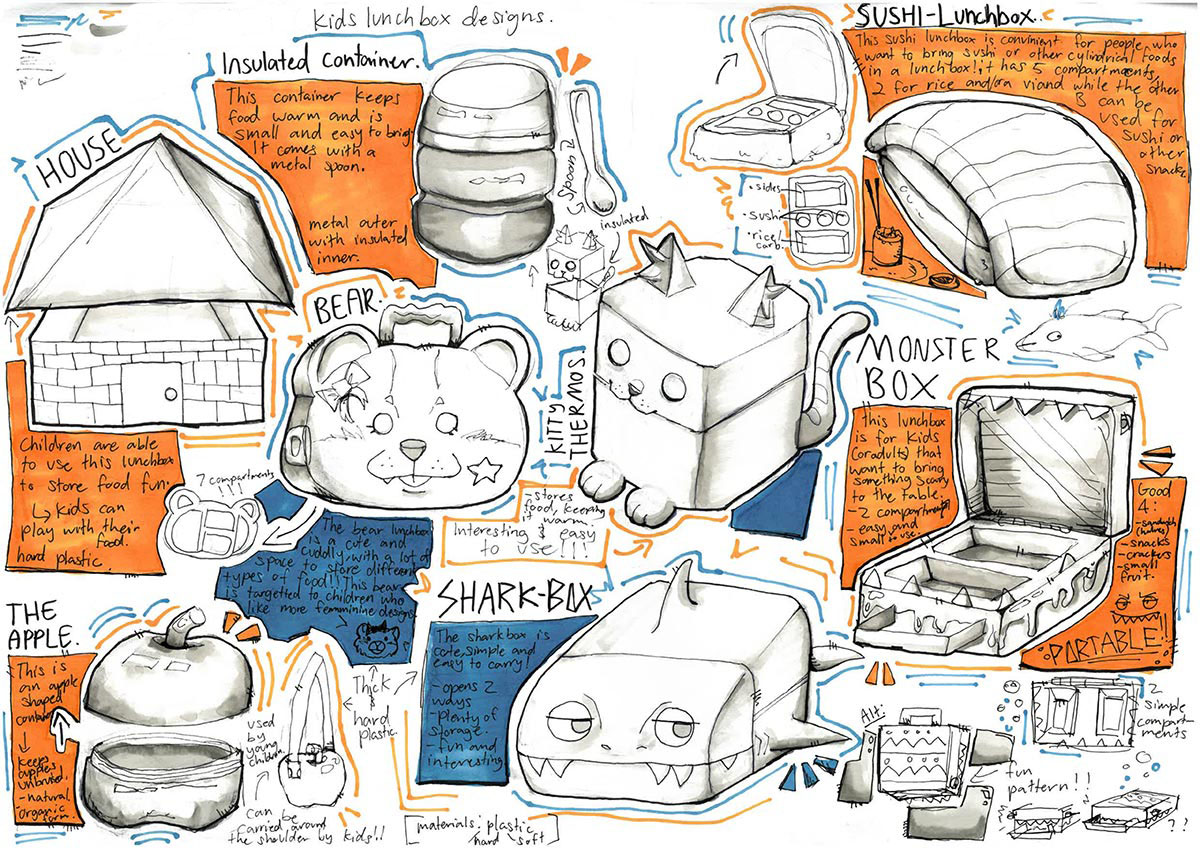
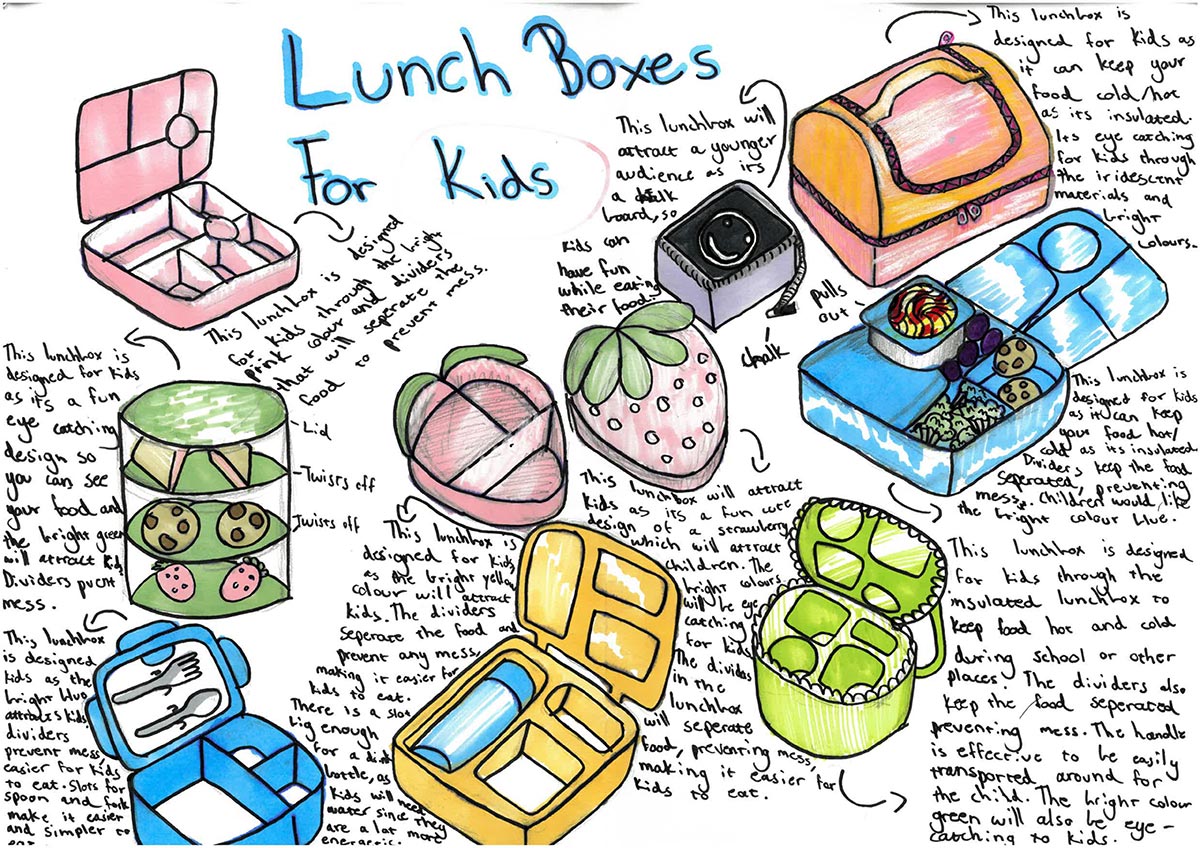
Students generate a range of design ideas for a sustainable lunch box solution, using annotated ideation sketches to explore different possible responses to the design problem.
Building on their earlier research, students develop at least eight different ideas that respond to the audience, purpose and context of the brief.
Each idea is supported by annotations that explain features of the design and consider how social, cultural, environmental and economic factors may influence design decisions.
Students also begin applying sustainable and circular design thinking, considering how their ideas might reduce waste, respond to material use and create more durable and responsible design outcomes.
CONNECTING TO THE STUDY DESIGN
This task moves into the Develop stage of the VCD design process, where students use divergent thinking to generate and explore a broad range of possible design directions.
Students build on their understanding of influences on design by applying research findings to their own object ideas, rather than only analysing the work of others.
The task also aligns with the study design through the use of manual drawing methods, the application of design terminology in annotations, and the consideration of sustainable and circular design practices.
By producing multiple ideas before refining a final direction, students begin working in ways that reflect professional design practice, where experimentation, testing and evaluation are essential to the development of strong outcomes.
Tips
Begin by revisiting the research task and asking students to identify which design influences should be visible in their own ideas.
Reinforce that ideation is about range and exploration, not perfection, and that quick manual sketches are often more useful than spending too long refining a single concept.
Model one example idea on the board, showing how a simple sketch can be supported by short annotations about audience, purpose, context and sustainability.
Encourage students to vary form, features, materials and functions across their eight ideas so that the page demonstrates genuine divergent thinking rather than minor adjustments to the same concept.
Developing design ideas for a sustainable object
| Task items | 1-2 (Very low) | 3-4 (Low) | 5-6 (Medium) | 7/8 (High) | 9/10 (Very high) |
|---|---|---|---|---|---|
|
Range of ideation sketches Number and variety of design ideas Evidence of divergent thinking |
Very few ideas are generated. Ideas show little variation or exploration. |
Some ideas are generated but variation is limited. Designs appear repetitive or only slightly different. |
A reasonable range of ideas is presented. Sketches show some variation in form, features or structure. |
A strong range of ideas is developed. Designs demonstrate clear exploration of different possibilities. |
A highly diverse and thoughtful range of ideas is generated. Sketches demonstrate expansive divergent thinking and creative exploration. |
|
Relevance to purpose, audience and context Alignment of ideas to the design problem Consideration of user needs |
Ideas show little connection to the design problem. User needs are not considered. |
Some connection to the design problem is visible. Consideration of users is limited or unclear. |
Ideas generally relate to the design problem. Some awareness of user needs is demonstrated. |
Ideas clearly respond to the purpose, audience and context. Designs demonstrate thoughtful consideration of user needs. |
Ideas demonstrate strong alignment with the design problem. User needs, context and purpose are thoughtfully integrated into design decisions. |
|
Consideration of design influences Social, cultural, environmental, economic and technological factors Awareness of sustainability |
Design influences are not considered. Ideas show no awareness of context or sustainability. |
One influence may be mentioned but with limited explanation. Sustainability considerations are unclear. |
Several relevant influences are identified. Basic consideration of sustainability is evident. |
Influences on design are considered clearly. Sustainability and circular design thinking inform ideas. |
Influences are integrated thoughtfully and insightfully. Ideas demonstrate strong awareness of sustainability and contextual design factors. |
|
Quality of visual communication Clarity of sketches and layout Ability of drawings to communicate ideas |
Drawings are unclear or incomplete. Ideas are difficult to interpret visually. |
Drawings communicate ideas weakly. Some elements are difficult to understand. |
Drawings communicate ideas adequately. Most sketches are understandable. |
Drawings communicate ideas clearly and effectively. Visual presentation supports understanding of the designs. |
Visual communication is highly effective. Sketches clearly and confidently communicate complex ideas. |
|
Use of design terminology in annotations Reference to purpose, audience, context or factors Terminology supports explanation of ideas |
Annotations are missing or unclear. Design terminology is not used. |
Limited annotations are provided. Terminology may be inaccurate or unclear. |
Some relevant annotations are included. Basic terminology is used correctly. |
Annotations clearly explain design ideas. Appropriate terminology is used accurately. |
Annotations demonstrate strong understanding of design thinking. Terminology is used confidently to justify design decisions. |
Key knowledge covered (Unit 1, Outcome 1 – Part 2)
| ✓ / ✗ | Key knowledge |
|---|---|
| ✗ | conceptions of good design across a range of design disciplines and contexts |
| ✓ | the role of visual language in producing good design outcomes |
| ✓ | the Discover and Define stages of the VCD design process |
| ✓ | techniques for effective collaboration in reframing human-centred design problems and identifying communication needs |
| ✓ | human-centred research methods including ethical design research practices |
| ✗ | strategies for convergent and divergent thinking |
| ✓ | techniques for the presentation of human-centred research findings |
| ✗ | the contents of a brief and its role in reframing ill-defined design problems |
| ✓ | design terminology used in research, analysis and evaluation |
Key skills covered (Unit 1, Outcome 1 – Part 2)
| ✓ / ✗ | Key skills |
|---|---|
| ✗ | identify and analyse past, present and personal conceptions of good design across various design fields |
| ✗ | formulate ideas about good design in future contexts |
| ✗ | use conceptions of good design to identify human-centred design problems |
| ✓ | collaborate with others to explore and reframe design problems using human-centred and ethical research methods |
| ✓ | apply the Discover and Define stages of the VCD design process |
| ✓ | present human-centred research findings |
| ✗ | compose a brief identifying a communication need |
| ✓ | use appropriate design terminology in research, analysis and evaluation |
Example
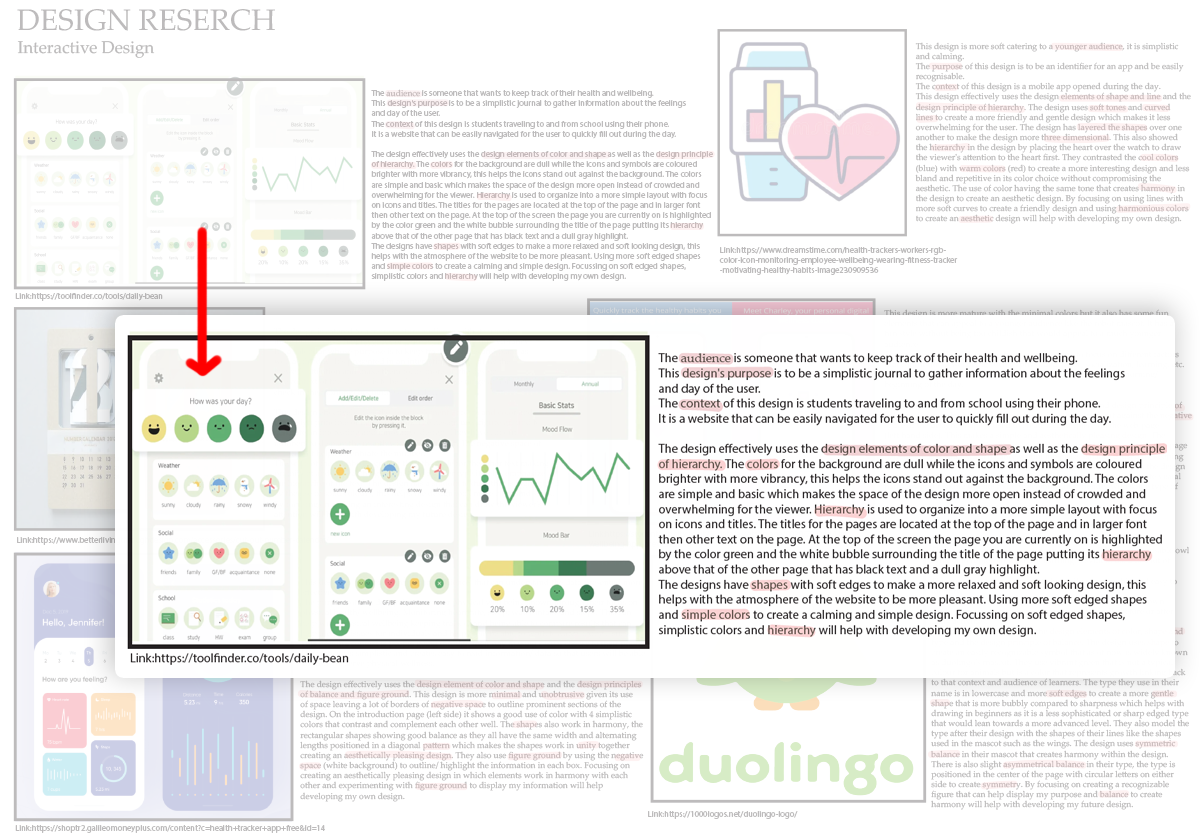
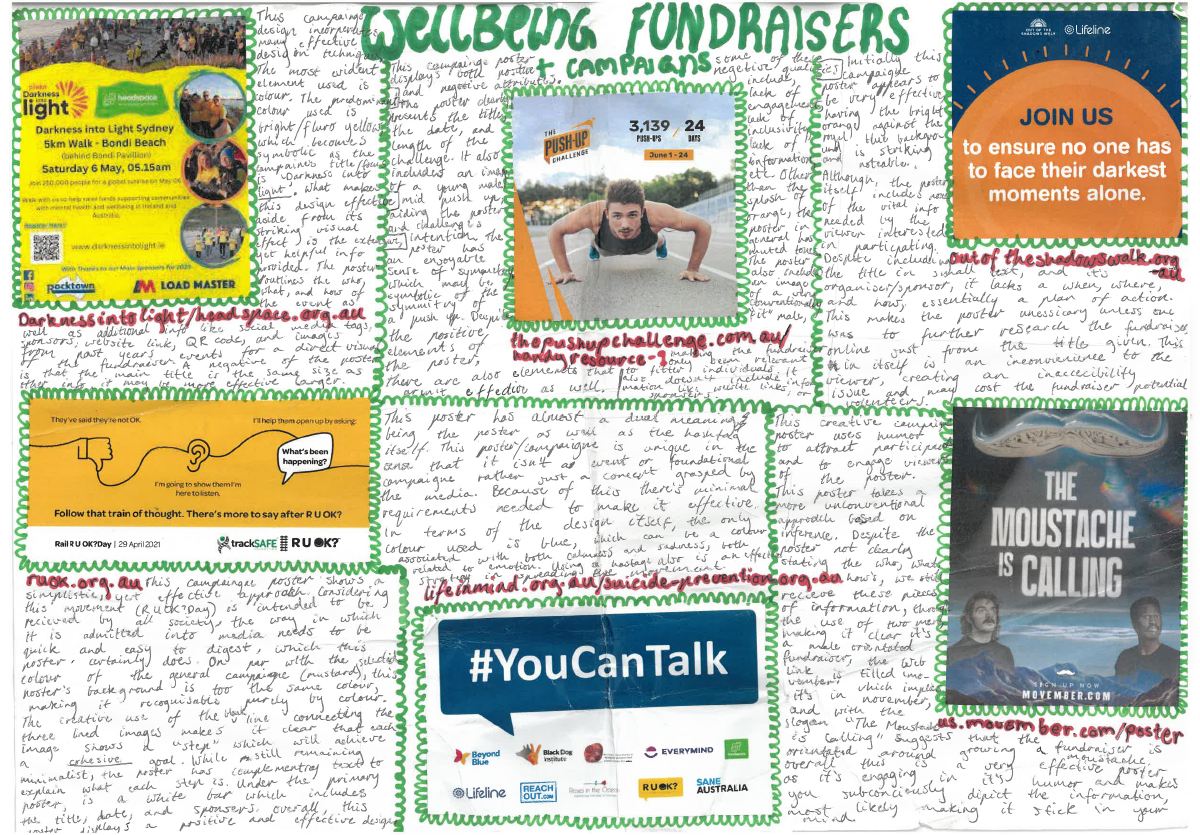
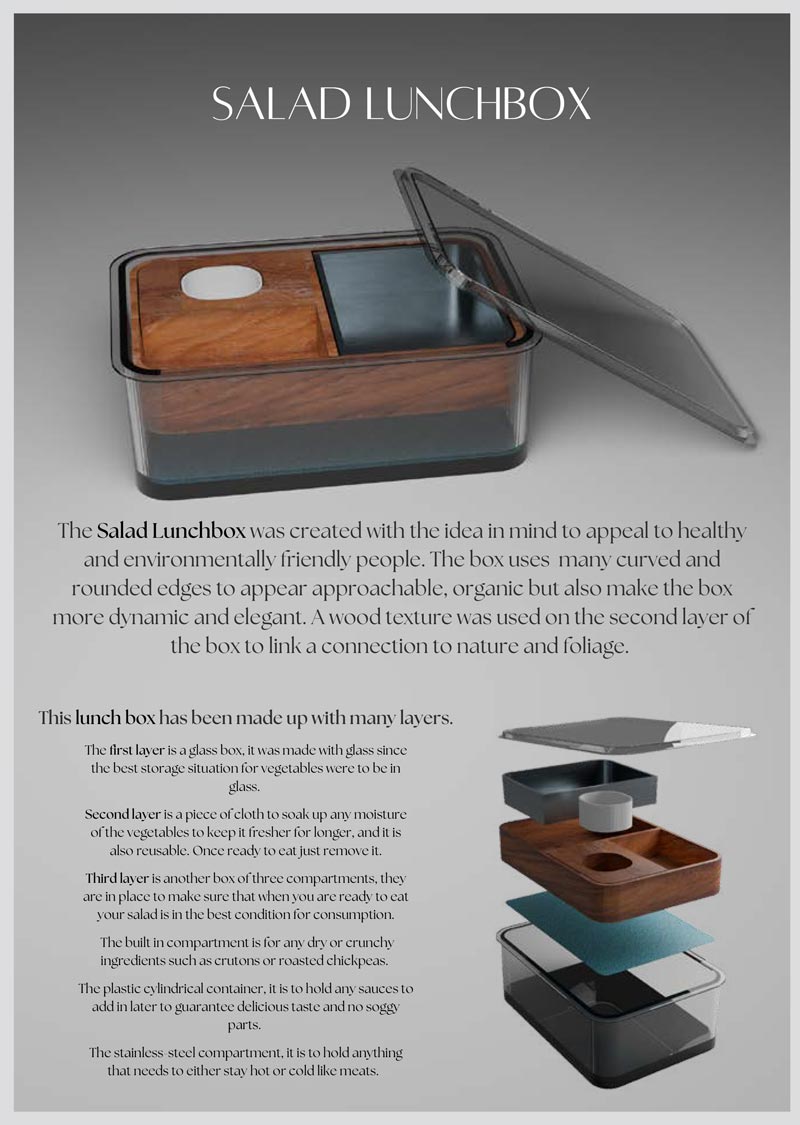
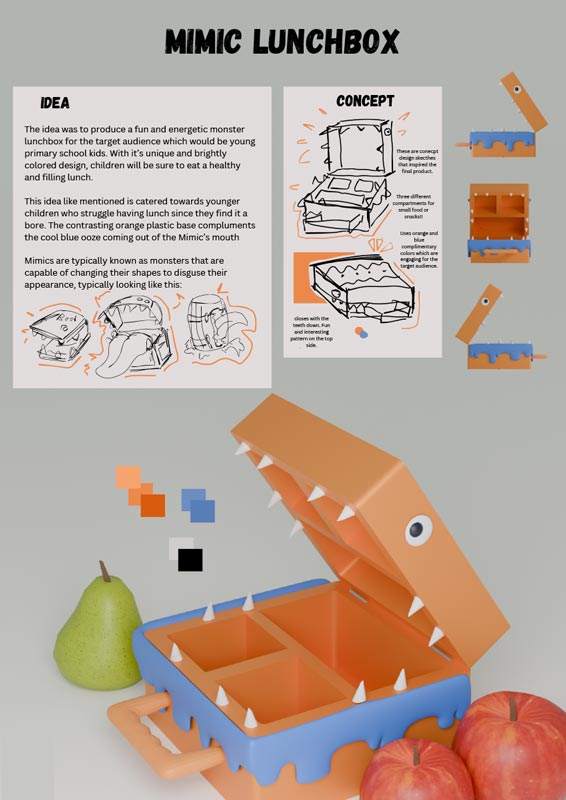
Student example 1
Example
Student example 2
Example
Student example 3
3. DESIGN ELEMENTS
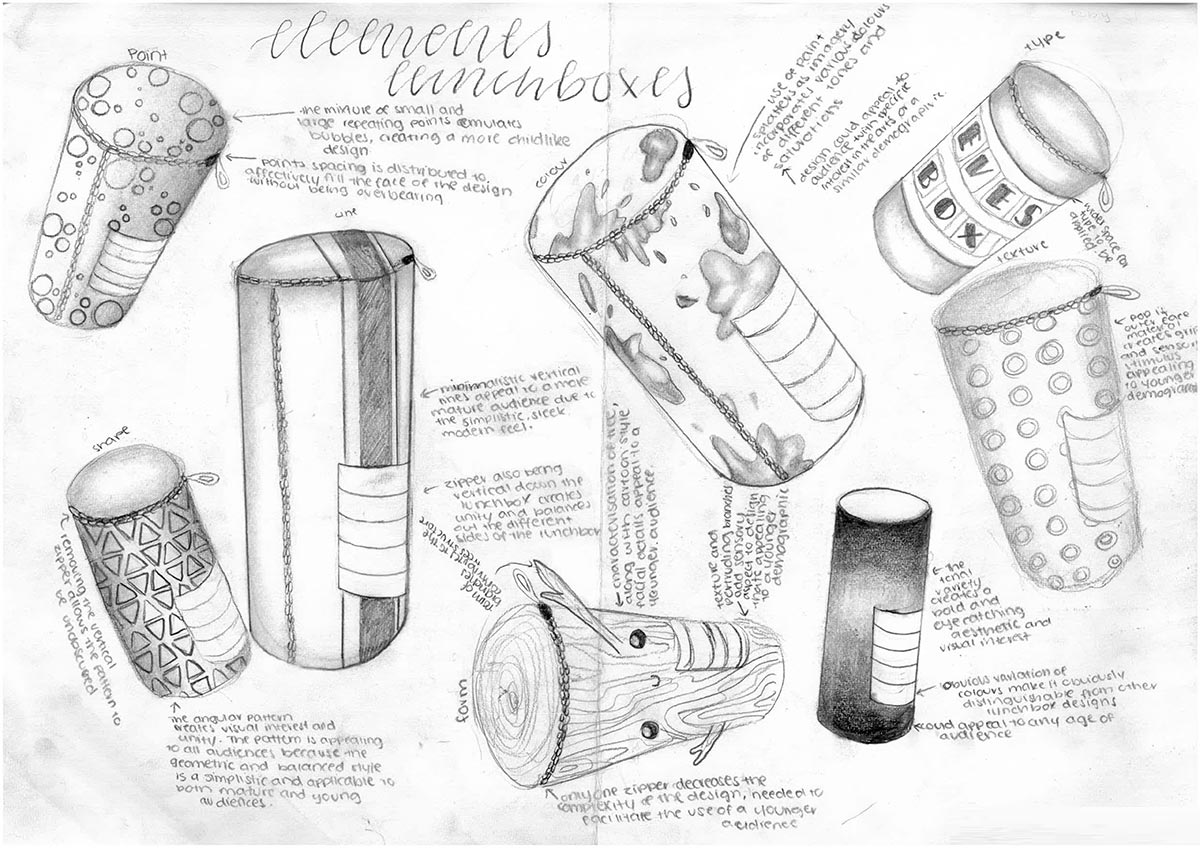
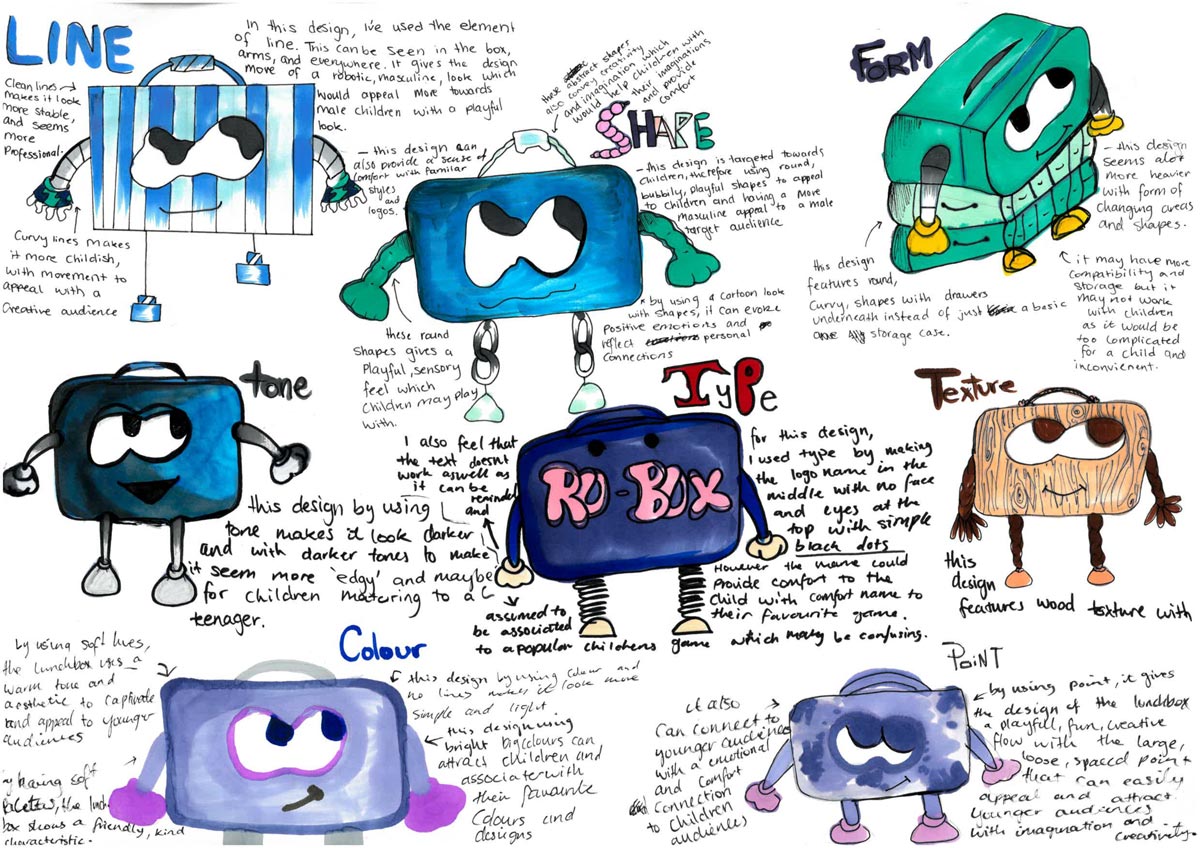
Students refine their design ideas by experimenting with design elements to communicate form, material qualities and visual interest in their sustainable object.
Building on earlier ideation sketches, students select several promising ideas and develop them further using design elements such as line, shape, form, colour, tone and texture.
Through drawing and annotation, students explore how these visual components influence the appearance, usability and communication of their design.
Students consider how the thoughtful use of design elements can enhance the functionality and aesthetic qualities of the object while supporting sustainable design intentions.
CONNECTING TO THE STUDY DESIGN
This task continues the Develop stage of the VCD design process, where ideas are tested and refined through drawing and visual exploration.
Students learn that design elements are the visual building blocks used by designers to construct and communicate ideas across all design fields.
By deliberately applying elements such as colour, form and texture, students begin to shape how their object will appear and function in the real world.
The task also reinforces the use of manual drawing methods and design terminology, supporting students’ ability to explain and evaluate their design decisions.
Tips
Begin by reviewing the design elements and discussing how each element can influence how a product looks and feels to a user.
Show examples of everyday objects where colour, texture or form strongly influence the user experience, such as drink bottles, lunch containers or packaging.
Model a quick sketch on the board demonstrating how a single object idea can be explored in multiple ways by changing colour, surface texture or form.
Encourage students to test several variations rather than committing to a single approach, reinforcing that experimentation is a key part of the design process.
Applying design elements to develop and communicate object ideas
| Task items | 1-2 (Very low) | 3-4 (Low) | 5-6 (Medium) | 7/8 (High) | 9/10 (Very high) |
|---|---|---|---|---|---|
|
Use of design elements Application of elements such as line, shape, form, colour, tone and texture Relevance to the design concept |
Design elements are rarely or incorrectly applied. Visual choices appear random or unrelated to the design idea. |
Limited use of design elements. Elements may be applied inconsistently or with little purpose. |
Several design elements are applied appropriately. Visual choices support the design idea in a basic way. |
Design elements are applied thoughtfully. Visual choices clearly support the function and appearance of the object. |
Design elements are applied confidently and strategically. Visual decisions significantly strengthen the design concept and communication. |
|
Exploration and refinement of ideas Development of variations or iterations Evidence of experimentation |
Little exploration of ideas is shown. Work remains minimal or incomplete. |
Some development of ideas is evident. Variations are limited or repetitive. |
A range of variations is explored. Ideas are developed and tested visually. |
Ideas are refined through clear experimentation and iteration. Development demonstrates thoughtful improvement of concepts. |
Extensive exploration and refinement is evident. Iterations demonstrate insightful experimentation and progression. |
|
Rendering and visual detail Use of tone, shading and surface representation Ability to communicate form and material qualities |
Rendering is minimal or absent. Form and materials are difficult to understand. |
Limited rendering techniques are applied. Form is partially communicated but lacks clarity. |
Basic rendering techniques are used. Form and material qualities are generally understandable. |
Rendering techniques clearly communicate form, surfaces and materials. Tone and shading enhance understanding of the design. |
Rendering techniques are applied skilfully and confidently. Visual detail strongly communicates form, depth and material qualities. |
|
Visual communication and presentation Clarity of drawings and layout Effectiveness in communicating the design idea |
Drawings are unclear or incomplete. Ideas are difficult to interpret visually. |
Drawings communicate ideas weakly. Some elements are difficult to interpret. |
Drawings communicate ideas adequately. Layout generally supports understanding. |
Visual presentation clearly communicates ideas. Layout and drawings support understanding of the design. |
Visual communication is highly effective and engaging. Drawings and layout clearly convey complex ideas. |
|
Use of annotations and terminology Explanation of design decisions Correct use of design terminology |
Annotations are missing or unclear. Design terminology is not used. |
Limited annotations are included. Terminology may be inaccurate or incomplete. |
Annotations explain ideas in a basic way. Some design terminology is used correctly. |
Annotations clearly explain design decisions. Terminology is used appropriately and consistently. |
Annotations demonstrate deep understanding of the design process. Terminology is used confidently to justify visual and functional decisions. |
Key knowledge covered (Unit 1, Outcome 3 – Task 3)
| ✓ / ✗ | Key knowledge |
|---|---|
| ✗ | influences on design such as economic, technological, cultural, environmental and social factors |
| ✗ | the influence of design on behaviours, interactions, systems and outcomes |
| ✗ | sustainable and circular design practices, and their value |
| ✓ | manual and digital methods, design elements and principles relevant to the design of three-dimensional objects |
| ✓ | rendering techniques used to simulate surfaces, materials, texture and form, and depict the direction of light, shade and shadow |
| ✗ | technical drawing conventions appropriate for the documentation of object designs |
| ✓ | appropriate design terminology |
Key skills covered (Unit 1, Outcome 3 – Task 3)
| ✓ / ✗ | Key skills |
|---|---|
| ✗ | research and analyse past and present influences on design |
| ✗ | research and analyse the influence of design in past and present contexts |
| ✓ | select and use appropriate manual and/or digital methods, media and materials to represent and render forms |
| ✓ | select appropriate design elements and principles when developing a sustainable object |
| ✗ | adopt circular design practices during the Develop and Deliver stages of the VCD design process |
| ✓ | annotate design ideas and concepts using design terminology |
| ✗ | apply two-dimensional drawing methods, such as technical flats or third-angle orthogonal projections, to depict objects from multiple views |
| ✓ | apply three-dimensional drawing methods, such as isometric or perspective drawing, to represent the form and structure of objects |
| ✗ | apply appropriate technical drawing conventions to documentation drawings |
4. DESIGN PRINCIPLES
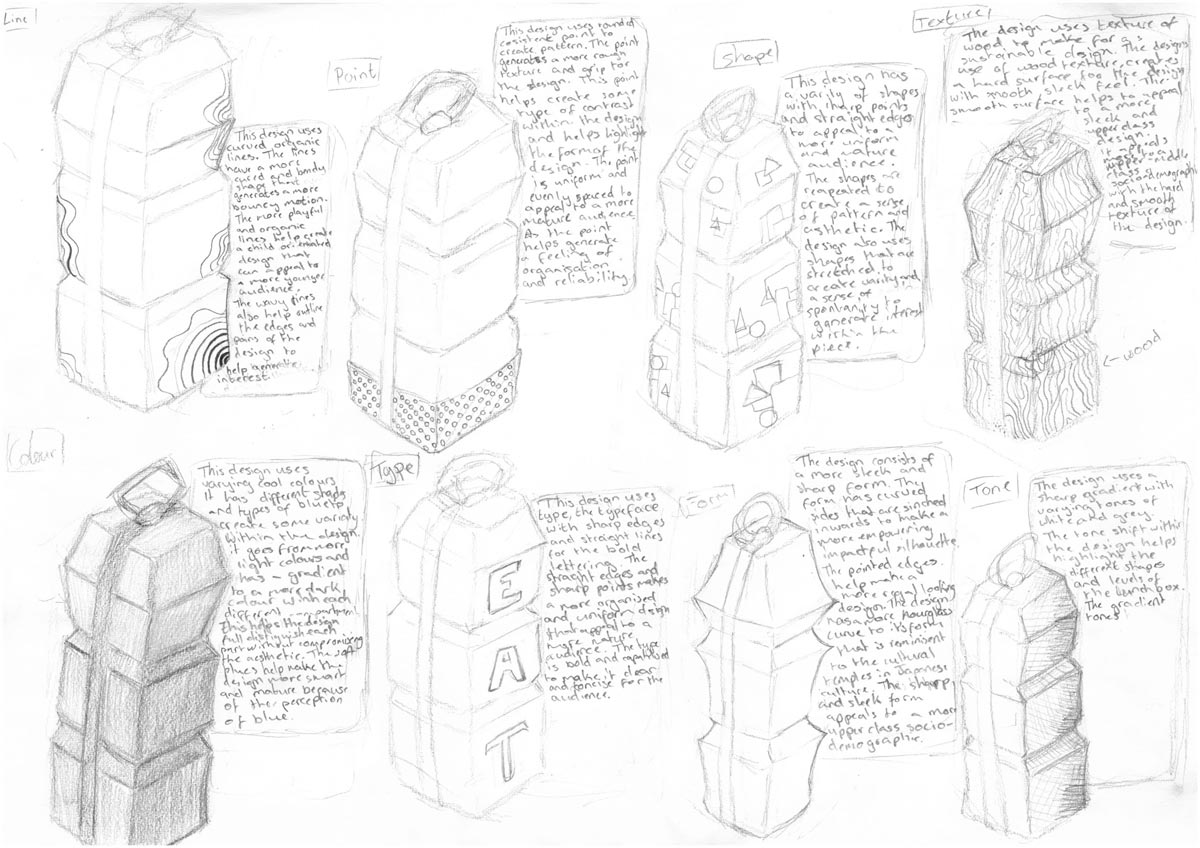
Students refine their design concepts by applying design principles to improve the visual organisation, usability and communication of their sustainable object.
Building on their previous exploration of design elements, students develop selected ideas further by applying principles such as hierarchy, balance, contrast, scale and proportion.
Through drawing and annotation, students investigate how these principles influence how a product is structured, how features are prioritised and how the design is experienced by users.
Students experiment with different arrangements and refinements to strengthen both the functionality and visual clarity of their object design.
CONNECTING TO THE STUDY DESIGN
This task continues the Develop stage of the VCD design process, where designers refine and improve ideas through visual experimentation and evaluation.
Students learn that design principles help organise visual elements and guide how a design is interpreted and used.
By deliberately applying principles such as hierarchy, balance and contrast, students begin shaping how their object communicates function, usability and importance of features.
The task also strengthens students’ ability to use design terminology when explaining how visual decisions influence the effectiveness of a design.
Tips
Begin by revisiting the design principles and discussing how they help organise visual information and guide how people interact with a design.
Show examples of everyday objects where hierarchy, balance or contrast influence usability, such as packaging, water bottles or lunch containers.
Model a quick sketch on the board demonstrating how the same object idea can be improved by adjusting scale, hierarchy or balance.
Encourage students to refine their strongest concept rather than producing completely new ideas, focusing on improving structure, clarity and usability through design principles.
Applying design principles to refine and improve object ideas
| Task items | 1-2 (Very low) | 3-4 (Low) | 5-6 (Medium) | 7/8 (High) | 9/10 (Very high) |
|---|---|---|---|---|---|
|
Application of design principles Use of hierarchy, balance, contrast, scale or proportion Relevance to the design concept |
Design principles are rarely applied or are used incorrectly. Visual structure does not support the design idea. |
Limited application of design principles. Principles may be applied inconsistently or without clear purpose. |
Several design principles are applied appropriately. Visual organisation supports the design concept in a basic way. |
Design principles are applied thoughtfully. Visual organisation clearly strengthens the usability and appearance of the object. |
Design principles are applied strategically and confidently. Visual organisation significantly improves the effectiveness of the design. |
|
Refinement of ideas Evidence of improvement from earlier concepts Consideration of usability and function |
Ideas show little development from earlier sketches. Improvements or refinements are not evident. |
Some refinements are made but improvements are limited. Changes may not clearly improve the design. |
Ideas are developed and refined in a reasonable way. Some improvements to function or clarity are visible. |
Ideas are clearly refined and improved. Design decisions strengthen usability and visual clarity. |
Refinement is insightful and purposeful. Improvements significantly enhance both functionality and communication. |
|
Communication of form and structure Use of drawing to show relationships between parts Clarity of structure and organisation |
Structure of the object is unclear. Drawings do not effectively communicate the design. |
Some aspects of the design structure are visible. Drawings communicate ideas with limited clarity. |
Drawings communicate the structure of the object adequately. Relationships between parts are generally understandable. |
Drawings clearly communicate form and structure. Organisation of parts and features is easy to interpret. |
Visual communication of form and structure is highly effective. Drawings clearly and confidently communicate complex design relationships. |
|
Visual organisation and presentation Layout, clarity and readability of drawings Effectiveness in communicating the design idea |
Layout is unclear or disorganised. Ideas are difficult to interpret visually. |
Visual organisation is limited. Some drawings are difficult to understand. |
Layout communicates ideas adequately. Most drawings are readable and understandable. |
Visual organisation supports understanding of the design. Layout clearly communicates the refined concept. |
Visual organisation enhances communication of ideas. Layout guides the viewer clearly through the refined design. |
|
Use of annotations and terminology Explanation of design decisions Correct use of design terminology |
Annotations are missing or unclear. Design terminology is not used. |
Limited annotations are provided. Terminology may be inaccurate or incomplete. |
Annotations explain ideas in a basic way. Some design terminology is used correctly. |
Annotations clearly explain design decisions. Terminology is used appropriately and consistently. |
Annotations demonstrate strong understanding of design thinking. Terminology is used confidently to justify design decisions. |
Key knowledge covered (Unit 1, Outcome 3 – Task 4)
| ✓ / ✗ | Key knowledge |
|---|---|
| ✗ | influences on design such as economic, technological, cultural, environmental and social factors |
| ✗ | the influence of design on behaviours, interactions, systems and outcomes |
| ✗ | sustainable and circular design practices, and their value |
| ✓ | manual and digital methods, design elements and principles relevant to the design of three-dimensional objects |
| ✓ | rendering techniques used to simulate surfaces, materials, texture and form, and depict the direction of light, shade and shadow |
| ✗ | technical drawing conventions appropriate for the documentation of object designs |
| ✓ | appropriate design terminology |
Key skills covered (Unit 1, Outcome 3 – Task 4)
| ✓ / ✗ | Key skills |
|---|---|
| ✗ | research and analyse past and present influences on design |
| ✗ | research and analyse the influence of design in past and present contexts |
| ✓ | select and use appropriate manual and/or digital methods, media and materials to represent and render forms |
| ✓ | select appropriate design elements and principles when developing a sustainable object |
| ✗ | adopt circular design practices during the Develop and Deliver stages of the VCD design process |
| ✓ | annotate design ideas and concepts using design terminology |
| ✗ | apply two-dimensional drawing methods, such as technical flats or third-angle orthogonal projections, to depict objects from multiple views |
| ✓ | apply three-dimensional drawing methods, such as isometric or perspective drawing, to represent the form and structure of objects |
| ✗ | apply appropriate technical drawing conventions to documentation drawings |
5. DESIGN SOLUTION
Students produce a final design solution for their sustainable object, integrating ideas developed throughout the previous tasks.
Using appropriate drawing systems such as isometric or perspective drawing, students communicate the form, structure and key features of their object design.
Rendering techniques are applied to represent materials, surfaces, texture and the direction of light, shade and shadow.
The final design communicates how the object functions and how design elements and principles contribute to its usability, sustainability and visual clarity.
CONNECTING TO THE STUDY DESIGN
This task represents the Deliver stage of the VCD design process, where designers communicate their final solution clearly to an audience.
Students consolidate their understanding of how design elements and principles shape the appearance and effectiveness of object designs.
The task also reinforces the use of drawing systems to communicate three-dimensional form, an essential skill in object design.
By applying rendering techniques and clear visual communication, students demonstrate how designers present ideas professionally to stakeholders.
Tips
Begin by revisiting students’ strongest concept from earlier tasks and discuss what makes it the most successful solution.
Demonstrate how a final drawing should clearly communicate the form, materials and key features of an object using rendering and shading.
Encourage students to plan their layout carefully so the drawing is clear and easy to interpret.
Remind students that the final design solution should reflect improvements made throughout the design process rather than introducing a completely new idea.
Communicating a final object design solution
| Task items | 1–2 (Very low) | 3–4 (Low) | 5–6 (Medium) | 7–8 (High) | 9–10 (Very high) |
|---|---|---|---|---|---|
|
Communication of the design solution Clarity of the object concept How effectively the design idea is presented |
The design idea is unclear or incomplete. The solution is difficult to interpret. |
The design idea is partially communicated. Some aspects of the solution are unclear. |
The design idea is generally understandable. The solution communicates the basic concept. |
The design idea is clearly communicated. The solution is easy to understand and well presented. |
The design idea is communicated clearly and confidently. The solution demonstrates strong visual communication and clarity. |
|
Use of drawing systems Representation of three-dimensional form Accuracy and clarity of the drawing method |
Drawing system is not used or used incorrectly. Form of the object is unclear. |
Drawing system shows limited accuracy. The form of the object is partially communicated. |
Drawing system communicates the object reasonably well. Some aspects of form are clear. |
Drawing system clearly communicates the object’s form and structure. Drawing method is applied effectively. |
Drawing system is applied confidently and accurately. The object’s form and structure are communicated clearly and professionally. |
|
Rendering techniques Representation of materials, surfaces and texture Use of light, shade and shadow |
Rendering is absent or ineffective. Materials and surfaces are not communicated. |
Limited rendering techniques are used. Materials and surfaces are unclear. |
Rendering techniques communicate materials in a basic way. Some shading and surface detail is evident. |
Rendering techniques clearly communicate materials and surfaces. Light and shade enhance the drawing. |
Rendering techniques are applied confidently and effectively. Materials, surfaces and form are communicated clearly and realistically. |
|
Application of design elements and principles Organisation of visual information Effectiveness of the overall design |
Design elements and principles are not evident. Visual organisation is unclear. |
Limited application of design elements and principles. Organisation of the design is inconsistent. |
Some design elements and principles are applied appropriately. The design communicates the concept in a basic way. |
Design elements and principles are applied effectively. Visual organisation supports understanding of the design. |
Design elements and principles are applied thoughtfully and strategically. Visual organisation strengthens the effectiveness of the design. |
|
Annotations and design terminology Explanation of design decisions Use of appropriate terminology |
Annotations are missing or unclear. Design terminology is not used. |
Limited annotations are included. Terminology may be inaccurate or unclear. |
Annotations explain ideas in a basic way. Some correct terminology is used. |
Annotations clearly explain design decisions. Terminology is used accurately and appropriately. |
Annotations demonstrate strong understanding of design thinking. Terminology is used confidently to justify design decisions. |
Key knowledge covered (Unit 1, Outcome 3 – Task 5)
| ✓ / ✗ | Key knowledge |
|---|---|
| ✗ | influences on design such as economic, technological, cultural, environmental and social factors |
| ✗ | the influence of design on behaviours, interactions, systems and outcomes |
| ✓ | sustainable and circular design practices, and their value |
| ✓ | manual and digital methods, design elements and principles relevant to the design of three-dimensional objects |
| ✓ | rendering techniques used to simulate surfaces, materials, texture and form, and depict the direction of light, shade and shadow |
| ✗ | technical drawing conventions appropriate for the documentation of object designs |
| ✓ | appropriate design terminology |
Key skills covered (Unit 1, Outcome 3 – Task 5)
| ✓ / ✗ | Key skills |
|---|---|
| ✗ | research and analyse past and present influences on design |
| ✗ | research and analyse the influence of design in past and present contexts |
| ✓ | select and use appropriate manual and/or digital methods, media and materials to represent and render forms |
| ✓ | select appropriate design elements and principles when developing a sustainable object |
| ✓ | adopt circular design practices during the Develop and Deliver stages of the VCD design process |
| ✓ | annotate design ideas and concepts using design terminology |
| ✗ | apply two-dimensional drawing methods, such as technical flats or third-angle orthogonal projections, to depict objects from multiple views |
| ✓ | apply three-dimensional drawing methods, such as isometric or perspective drawing, to represent the form and structure of objects |
| ✗ | apply appropriate technical drawing conventions to documentation drawings |